Garage Door Repair in San Antonio, TX
Garage door repair typically runs $150–$350 nationally, per our cost guide. Independent local pros serving San Antonio, Alamo Heights, Leon Valley and nearby areas. Describe the problem and we'll route your request — free, no obligation.
- Mark broken springs and trapped cars as emergencies
- Honest national price ranges published up front
- Independent local techs — not a national call center
- Free to use — no obligation, no markup
Fast response from independent local providers. No obligation.
Typical national cost$150 – $350Cost guide →Local Help in San Antonio, TX
Inside San Antonio city limits, residential building permits come from the city's Development Services Department (DSD). The building rules it enforces are in Chapter 10 of the City Code, the Building-Related Codes. DSD's Codes & Ordinances page says the City Council adopted the 2024 International Code Council codes, the International Residential Code among them, on January 30, 2025, and links a print edition of Chapter 10 whose cover gives an effective date of May 1, 2025.
Two city documents speak to door jobs in different words: DSD's web list of projects that typically need no permit includes "Replacement of existing doors," while the code's exemption list in Sec. 10-6(e) does not name doors. Both are quoted under Permits below.
Chapter 10 also regulates who does the work. Under Sec. 10-115(a), anyone performing "any form of residential construction or home improvement work in the city" must work under a contractor registered with the city, subject to three exceptions quoted in the FAQs. Statewide electrical licensing, insurance and coastal windstorm rules are covered on our Texas page.
San Antonio Service Details
What providers in this area actually see: coverage, common jobs, local pricing factors, and rules worth knowing.
Service Area Notes
- San Antonio city spans Bexar, Comal and Medina counties according to the Census Bureau's 2020 place code file. Alamo Heights, Leon Valley, Helotes, Converse, Live Oak and Universal City are separate incorporated cities in Bexar County; Cibolo city is listed in Bexar and Guadalupe counties and Schertz city in Bexar, Comal and Guadalupe counties. For an address in any of them, the building office of that city, not San Antonio's DSD, is the place to ask about permits.
- Outside every city's limits, Bexar County's Public Works building-permit page says the county Fire Marshal's Office decides when building permits are required for structures or areas that are not for a "single-family dwelling" use, which the page defines as a single structure of three or fewer residential dwelling units. Ask the county about work at an unincorporated address.
Common Jobs in San Antonio
- Spring replacement: HomeGuide's spring guide, dated October 27, 2025, lists $150 to $350 for torsion springs and $120 to $200 for extension springs. It gives torsion springs a life of 7 to 14 years or 10,000 to 20,000 cycles, and extension springs 4 to 10 years or 5,000 to 15,000 cycles.
- Dented or hail-struck panels: HomeGuide's dent guide, dated July 17, 2025, prices minor dents at $100 to $300, moderate damage at $250 to $400, a single panel replacement for severe damage at $300 to $900, and replacement of several damaged panels at $600 to $1,500+.
- Tune-ups: HomeGuide's repair guide and its dent guide both put a garage door tune-up at $100 to $250, and the repair guide describes a typical tune-up as covering "inspection, adjustment, lubrication, safety checks, and minor repairs."
- Opener installation: all three HomeGuide guides put a new or replacement opener at $300 to $900. Where the job needs a new receptacle or circuit, the electrical rules under Permits apply.
What Drives Pricing Here
- Every dollar range in the job list comes from HomeGuide, and none of its three guides prints San Antonio or Texas prices. In the repair guide's words, the total cost "depends on the door type, material, extent of damage, and local labor rates."
- Permit cost, where a permit applies: Sec. 10-10 of Chapter 10 says fees follow the fee schedule adopted by the city and that the applicant supplies an estimated value of the work, including materials, labor and profit, which the Building Official may adjust. Ask DSD for the current fee rather than relying on an older figure. Under Sec. 10-10(d), anyone who starts work before obtaining a necessary permit is subject to double permit fees.
- Hail claims: TDI's windstorm insurance page says that anywhere in Texas apart from the coast, a homeowners policy probably covers wind and hail damage, and the windstorm deductible can differ from the one for other losses.
Permits & Local Rules
- DSD web list: the No Permit Required List page introduces its items as "construction or remodeling projects" that "typically do not require a permit," and one item is "Replacement of existing doors." The same page adds that if a property is in a Historic, Neighborhood Conservation or Corridor District, "there may be restrictions on the design and materials used." DSD's Residential Permits page adds that one project may need several permit types, such as building and electrical, depending on its scope.
- Chapter 10 text: Sec. 10-6(a) requires an owner or authorized agent to apply for and obtain the required permit before constructing, enlarging, altering, repairing, moving or demolishing a building or structure, changing its occupancy, or installing, altering, repairing or replacing an electrical, gas, mechanical or plumbing system regulated by the chapter. Sec. 10-6(e) lists exempt work, and states that being exempt from a permit grants no authorization for work done in violation of the chapter or of other city or state laws or ordinances. Sec. 10-6(g) requires no application or notice for "ordinary repairs to structures," but such repairs may not include cutting away any wall, partition or portion thereof; removing or cutting any structural beam or load-bearing support; removing or changing any required means of egress, or rearranging parts of a structure affecting egress; or adding to, altering, replacing or relocating "any standpipe, water supply, sewer, drainage, drain leader, gas, soil, waste, vent or similar piping, electric wiring or mechanical or other work affecting public health or general safety." Defective parts must be replaced or repaired so as to preserve the original approval or listing.
- Electrical: the electrical items in Sec. 10-6(e)(2) that need no permit begin with "Minor repairs or maintenance work when performed by a licensed electrical contractor, the replacement of lamps or the connection of approved portable electrical equipment to approved permanently installed receptacles." Sec. 10-113(b) requires state-licensed electrical contractors to register with the city before performing electrical work the chapter regulates.
- Historic properties: the Office of Historic Preservation says that, per the Unified Development Code, all exterior modifications and repairs on properties with a historic zoning overlay (zoned H, HS, HE or HL) need a Certificate of Appropriateness, including side and rear yards and areas not readily visible from the street. It warns that work started without one may result in a Stop Work Order and, in more serious cases, a municipal case. OHP's Explorer Map shows a parcel's designation.
Climate & Housing Notes
- Climate: at San Antonio International Airport (station USW00012921, named SAN ANTONIO INTL AP, TX US), the 1991–2020 annual normals published by NCEI average 122.4 days a year reaching 90°F or higher and 17.7 days reaching 100°F or higher, with 14.0 days a year when the low reaches 32°F or below and 32.38 inches of normal annual precipitation.
- Hail on record: the NWS Austin/San Antonio office's event summary for April 12, 2016 describes a storm that dropped a large swath of very large hail just north of downtown, with multiple reports of 2 to 3 inch hail. The largest stone reported to the office measured 4.5 inches and fell about 3 miles southeast of Helotes. The summary puts damage estimates at around $1.36 billion.
- Windstorm certificates: TDI's WPI-8 fact sheet describes the WPI-8 as the compliance certificate for property, repairs or additions on the Texas coast, and Bexar County is not among the counties it lists.
Neighborhoods & Suburbs Served
San Antonio · Alamo Heights · Leon Valley · Helotes · Converse · Live Oak · Universal City · Schertz · Cibolo
Emergency Response Expectations
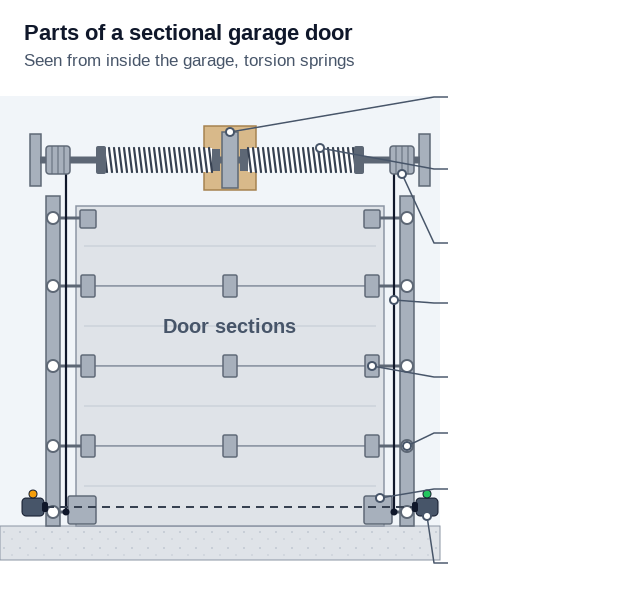
The door industry's TDS-167 checklist from DASMA (Rev 4/23) is blunt about a failed spring: "If a spring is broken, do not operate the door until the spring is replaced." It leaves all repairs and adjustments to a trained door systems technician with proper tools and instructions. Its spring containment item notes that torsion springs mounted on a shaft are inherently contained, and for extension springs it asks the inspector to verify a secure cable running through the center of the springs, because containment helps keep broken parts from flying dangerously in the garage. No arrival time can be promised for any request.
San Antonio FAQs
Do I need a city permit to replace my garage door in San Antonio?
Possibly not, but confirm with DSD first: its web list and Chapter 10, both quoted under Permits, are worded differently, and the code's ordinary-repair rule excludes structural, egress, piping and wiring changes, among others. Mention any change to the opening, header or framing, or new opener wiring, when you ask. On a property with a historic zoning overlay, exterior modifications and repairs also need a Certificate of Appropriateness from the Office of Historic Preservation.
Must the company doing my door be registered with San Antonio?
Sec. 10-115(a) requires residential construction or home improvement work in the city to be done under a city-registered contractor. Sec. 10-25 defines home improvement, starting with "the repair, replacement, remodeling, alteration, conversion, or modernization" of an existing building, not owned by a government agency, used or designed as a residence for not more than two families, and lists what it excludes, including sales by a seller who neither performs nor arranges any installation work. The three exceptions to registration are: "Any person who will own a detached single-family dwelling for a period of twelve (12) months after completion of the building permit and final inspection for the single-family dwelling or accessory building thereto"; building trade subcontractors working for the residential building contractor; and "Any person who will repair, replace, or modify non-structural building components to an existing residential detached accessory structure not exceeding 300 square feet." DSD's Contractor Search is limited to businesses registered with the city, and it also shows contractors whose license has expired, for reference.
What insurance must a city-registered home improvement contractor carry?
Sec. 10-115(b)(3) sets minimums of $300,000 per occurrence, combined for property damage and bodily injury; $600,000 aggregate; and $300,000 aggregate for products and completed operations, with the City of San Antonio listed as certificate holder and, under Sec. 10-115(b)(5), the insurance certificate written through a company licensed to issue the insurance in the state. Under Sec. 10-115(b)(1), a registered contractor must give any customer who asks the name of the insurance carrier, the policy number and the insurance agent's name, address and telephone number.
Can a new opener go in without an electrical permit?
That depends on the wiring. Chapter 10's electrical exemption and its ordinary-repair rule both mention "the connection of approved portable electrical equipment to approved permanently installed receptacles," while the ordinary-repair rule excludes adding to, altering, replacing or relocating electric wiring. Ask DSD whether your opener and outlet fit that exemption. At the state level, Occupations Code chapter 1305, which TDLR administers, defines electrical work to include labor or material used in installing, maintaining or extending an electrical wiring system, and requires a license for it unless an exemption in § 1305.003 applies; our Texas page explains those exemptions.
Before a move-out walkthrough, what opener checks does the federal standard describe?
Item 5 of the user instructions that 16 CFR 1211.16(b)(2) requires manufacturers to include begins "Test door opener monthly"; the door is to reverse when it touches a 1 1/2 inch object, or a 2 by 4 lying flat, on the floor, and the opener is to be retested whenever the force or the travel limit is adjusted. Item 9 reads "SAVE THESE INSTRUCTIONS." Item 7 assigns repairs to cables, spring assemblies and other hardware to "a qualified service person." Part 1211 covers residential openers made on or after January 1, 1993 for U.S. sale.
Sources
- City of San Antonio DSD: No Permit Required List
- City of San Antonio DSD: Residential Permits
- City of San Antonio DSD: Codes & Ordinances (2024 codes adopted January 30, 2025)
- San Antonio City Code Chapter 10, Building-Related Codes, print edition effective May 1, 2025 (Secs. 10-6, 10-10, 10-25, 10-113, 10-115)
- City of San Antonio DSD: Building & Home Improvement contractor registration
- City of San Antonio DSD: Contractor Search
- City of San Antonio Office of Historic Preservation: Before Getting Started
- Bexar County Public Works: Building Permits
- Texas Occupations Code ch. 1305, electricians
- Texas Department of Licensing and Regulation: Electricians
- Texas Department of Insurance: What is windstorm insurance? (updated 6/1/2026)
- Texas Department of Insurance: WPI-8 fact sheet
- eCFR: 16 CFR part 1211, automatic residential garage door operators
- NOAA NCEI 1991–2020 annual normals, San Antonio Intl AP (USW00012921)
- NWS Austin/San Antonio: Weather Event Summary, San Antonio hail, April 12, 2016
- U.S. Census Bureau: 2020 place codes, Texas
- DASMA TDS-167: Residential Sectional Garage Door and Electric Operator Checklist, Rev 4/23 (trade association)
- HomeGuide: Garage Door Repair Cost (third-party estimate, Jan. 6, 2026) (third-party estimate)
- HomeGuide: Garage Door Spring Replacement Cost (third-party estimate, Oct. 27, 2025) (third-party estimate)
- HomeGuide: Garage Door Dent Repair Cost (third-party estimate, July 17, 2025) (third-party estimate)
Last reviewed 2026-11-09
Services Available in San Antonio
Garage Door Repair
Springs, openers, cables, tracks, rollers, and panels — honest diagnosis and repair from independent local garage door techs.
Learn more →Garage Door Spring Repair
Broken torsion or extension springs replaced by local techs — the most common garage door failure, and not a DIY job.
Learn more →Garage Door Opener Repair
Openers that grind, hum, or won't respond — diagnosis and repair or replacement quotes from local techs.
Learn more →Garage Door Cable & Track Repair
Snapped cables, doors off track, and crooked or jammed doors — stop using the door and get a local tech routed fast.
Learn more →Emergency Garage Door Repair
Door stuck open at night, off its tracks, or trapping a vehicle — send an emergency request to independent local techs.
Learn more →Garage Door Replacement & Installation
New and replacement garage doors — steel, insulated, carriage-style, and wind-rated — with written installed quotes from local installers.
Learn more →Free Tools Before You Call
Ballpark the cost or narrow down the problem before talking to a San Antonio provider.
Garage Door Repair Cost Estimator
Estimate what your garage door repair should cost — springs, cables, openers, panels, and off-track doors, scheduled or emergency.
Use the free tool →Garage Door Symptom Diagnoser — Why Won't My Door Open?
Door won't open, won't close, or reverses on its own? Answer a few questions to find the likely cause — and whether it's a safe DIY fix or a pro job.
Use the free tool →Garage Door Torsion Spring Calculator
Measure your torsion spring — wire size, inside diameter, length — and check whether it's correctly sized for your door, with winding turns included.
Use the free tool →Need help in San Antonio, TX?
Send the short form — urgent requests get priority routing.