Garage Door Repair in Phoenix, AZ
Garage door repair typically runs $150–$350 nationally, per our cost guide. Independent local pros serving Ahwatukee Foothills, Deer Valley, Laveen and nearby areas. Describe the problem and we'll route your request — free, no obligation.
- Mark broken springs and trapped cars as emergencies
- Honest national price ranges published up front
- Independent local techs — not a national call center
- Free to use — no obligation, no markup
Fast response from independent local providers. No obligation.
Typical national cost$150 – $350Cost guide →Local Help in Phoenix, AZ
Inside Phoenix city limits, building permits are governed by the 2024 Phoenix Building Construction Code. The City Council approved it on June 18, 2025, and the Planning & Development Department (PDD) gives its effective date as August 1, 2025, under Ordinance G-7397.
For houses, the city's amended residential code marks its permit section (R105) as reserved and, for reserved sections, refers to the amendments and requirements in Chapter 1 of the International Building Code. There, Section 105.1 requires an owner or the owner's authorized agent to obtain the required permit before work such as altering or repairing a building or structure, or installing, altering, repairing or replacing a regulated electrical system. The amended Section 105.2 lists work exempt from permit, and it says an exemption is not to be read as authorization for work done in violation of the code or of any other City of Phoenix law or ordinance.
Census Bureau QuickFacts gives Phoenix city a population of 1,608,139 in the April 1, 2020 Census.
Phoenix Service Details
What providers in this area actually see: coverage, common jobs, local pricing factors, and rules worth knowing.
Service Area Notes
- The city says Phoenix is divided into 15 urban villages, each with a Village Planning Committee. Its list is Ahwatukee Foothills, Alhambra, Camelback East, Central City, Deer Valley, Desert View, Encanto, Estrella, Laveen, Maryvale, North Gateway, North Mountain, Paradise Valley, Rio Vista and South Mountain.
- The Phoenix code is adopted by the City of Phoenix. For an address in Glendale, Peoria or Tempe (each listed as a separate city in Census QuickFacts) or in any other city or town, ask that municipality's building office which rules apply. For unincorporated land, A.R.S. § 11-861 gives the board of supervisors, in a county that has adopted zoning, power to adopt and enforce a building code for the zoned unincorporated areas, and lets the board exempt areas zoned rural or unclassified.
Common Jobs in Phoenix
- Spring replacement, which HomeGuide's January 6, 2026 repair guide calls the most common garage door repair. Its October 27, 2025 spring guide lists, including materials and replacement labor, $150 to $350 for torsion springs, $200 to $400 for torsion springs and bar, $120 to $200 for extension springs and $200 to $500 for springs and cables.
- Opener motor replacement, priced with labor in HomeGuide's July 10, 2025 opener guide at $300 to $600 for chain drive, $300 to $700 for belt drive, $350 to $650 for screw drive and $400 to $800 for direct drive. The guide notes a motor replacement can cost as much as or more than a replacement opener.
- A new opener installed, at $300 to $900 on average in the same guide, which breaks that into $150 to $500 for the unit and $150 to $400 for labor and gives a $600 national average.
- Safety sensors: the repair guide's average for replacing a faulty sensor is $125 to $300. The opener guide says new sensors typically cost $25 to $100, that some estimates leave sensors out, and that a new opener system may not be compatible with existing sensors.
What Drives Pricing Here
- HomeGuide's figures on this page are not Phoenix prices. Its repair guide names the type of repair, door material, door style and design, extent of damage, labor and service fees, replacement parts and geographic location as the factors behind a bill, and says local demand, cost of living and the availability of skilled professionals make costs vary by area.
- Spring prices vary by door type: the spring guide lists $250 to $400 for insulated doors and $300 to $600 for double doors. It also says emergency repairs during evenings, weekends or holidays carry premium charges, and that limited headroom, unusual configurations or obstructed work areas take extra time and raise labor costs.
- Opener installs can cost more than the base price. The opener guide says installers may add $50 to $100 for an extension kit on doors taller than 7 to 8 feet. Where a garage has no existing electric opener, it says an electrician needs to install wiring, at $10 to $25 per linear foot to run electricity to a garage. Ask PDD whether new wiring at your address needs an electrical permit.
- Any Phoenix permit fee comes from the Planning & Development fee schedule (Phoenix City Code Chapter 9, Appendix A.2, as the 2024 amendments cite it); ask PDD for the current amount.
- ROC treats permits as the property owner's responsibility but notes that many contractors write permit costs and fees into the contract. Its hiring advice is to get written estimates from at least three contractors, each spelling out the price and who is responsible for obtaining building permits.
Permits & Local Rules
- Doors: among the building items in Phoenix's amended Section 105.2 is "Minor repair or replacement in kind of non-structural components such as, glass or glazing materials, sash, doors, patching walls or ceilings and replacing pieces of siding, soffits or facia." The same item adds that installing locking or security hardware on egress doors, or changing the types of locking devices, requires a permit. The item names doors in general, not garage doors; whether a particular job fits it, such as a different-size door or a change to the framed opening, is for PDD to decide. An older PDD handout still online (TRT/DOC/00618, Rev. 07/14) has the pre-2024 wording "doors and hardware"; rely on the current amendment.
- Openers and wiring: the electrical items in the same section exempt installing or replacing appliances and other utilization equipment "manufactured, approved and identified for cord- and plug-connection to suitable permanently installed receptacles". Another item exempts "Repair or replacement in kind of any switch, other than a service disconnect, receptacle, contactor, control device or other utilization equipment rated 60 amperes or less." For openers without a permanent wiring connection, 16 CFR 1211.16(b)(1)(iv) requires the installation instructions to say, in these or equivalent words, "This operator not equipped for permanent wiring. Contact licensed electrician to install a suitable receptacle if one is not available." Whether an opener install, a new ceiling receptacle or a new circuit fits a Phoenix exemption is a question for PDD.
- Garage receptacles: Phoenix's amendment to residential code section E3901.9 requires at least one receptacle outlet in each vehicle bay of an attached garage, and of a detached garage provided with electric power, at not less than 18 inches and not more than 5.5 feet above the floor. These are in addition to any receptacles provided for specific equipment. PDD can say how this applies to work on an existing garage.
- Licensing: Arizona's exemption for casual or minor work, A.R.S. § 32-1121(A)(14), has a price limit and several other conditions. This site's Arizona page sets them out in full. One condition ties it to the city: under (A)(14)(a) the exemption does not apply in any case in which performing the work requires a local building permit. Look up a contractor with the Registrar of Contractors (ROC) Contractor Search, and ROC advises checking that the license class covers the work listed in the contract.
- Planned communities: Arizona's planned-community statute defines a community's documents as "the declaration, bylaws, articles of incorporation, if any, and rules, if any" (A.R.S. § 33-1802). ROC adds that a homeowners association may restrict what you build, and how it is built, under its CC&Rs. Read those documents, and any approval process they set, before choosing a replacement door's style or color.
Climate & Housing Notes
- NOAA NCEI's 1991–2020 annual normals for Phoenix Sky Harbor International Airport (station USW00023183) list 111.3 days a year with a maximum temperature of 100°F or higher (ANN-TMAX-AVGNDS-GRTH100) and 173.4 days at 90°F or higher (ANN-TMAX-AVGNDS-GRTH090).
- The same station's normal annual precipitation is 7.22 inches (ANN-PRCP-NORMAL).
- HomeGuide's repair guide suggests lubricating pulleys, chains and tracks at least once a year. It describes a tune-up ($100 to $250) as usually covering inspection, adjustment, lubrication, safety checks and minor repairs.
Neighborhoods & Suburbs Served
Ahwatukee Foothills · Deer Valley · Laveen · Maryvale · Camelback East · North Mountain · Desert View · Estrella · South Mountain
Emergency Response Expectations
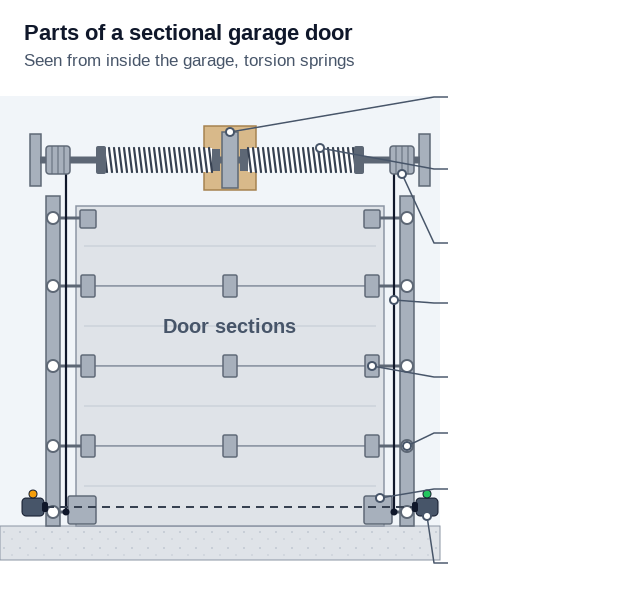
A door stuck part-way open is not something to walk under: "NEVER GO UNDER A STOPPED PARTIALLY OPEN DOOR" is one of the user instructions 16 CFR 1211.16 requires. HomeGuide's spring guide calls spring replacement extremely dangerous because of the springs' high tension and says to always hire a qualified professional for it. If the emergency release has to be used, the same federal instructions prefer a closed door where possible and call for caution with the door open, since "Weak or broken springs may allow the door to fall rapidly."
Phoenix FAQs
Does replacing a garage door in Phoenix need a city permit?
It depends on the job. Phoenix's 2024 code exempts minor repair or replacement in kind of non-structural components, with doors among its examples, but not locking or security hardware on egress doors or a change in the types of locking devices. Ask PDD before work starts about anything else, such as a different door size or a change to the opening.
Is a permit needed to put in a garage door opener in Phoenix?
Phoenix exempts equipment manufactured, approved and identified for cord- and plug-connection to suitable permanently installed receptacles, and some in-kind replacements quoted under Permits above. Ask PDD whether new wiring or a new outlet for the opener fits any exemption.
Can someone without an ROC license work on my garage door in Phoenix?
Only within an exemption in A.R.S. § 32-1121. The one for casual or minor work has a price limit and other conditions, listed on this site's Arizona page, and it never covers work that requires a local building permit. So if a Phoenix permit is needed, that exemption is out; unless another exemption in the section applies, hire an ROC-licensed contractor, and ask ROC if you are unsure.
What release handle must a garage door opener have?
Under 16 CFR 1211.9(a), the opener must come with a means to detach it from the door manually. Its handle must be red and easy to tell apart from the rest of the opener, and it must be capable of adjustment to 6 feet above the garage floor when the operator is installed according to its instructions. A hand applying no more than 50 pounds of force must be able to detach the operator with the door obstructed in the down position, and a marking with detaching instructions is required. Under 1211.9(b), none is required for an operator not directly attached to the door that lets the door be moved open from any position other than the last 2 inches of closing travel, and moved to the 2-inch point from any position between closed and that point. Under 1211.1 the part applies to residential operators made for U.S. sale on or after January 1, 1993. A CPSC direct final rule published October 30, 2026 amends other sections of the part to match UL 325 revisions; it takes effect December 29, 2026 unless CPSC receives significant adverse comments by November 30, 2026.
Where should the opener's wall button go?
The installation instructions that 16 CFR 1211.16 requires with every opener say to locate the control button within sight of the door. It goes at a minimum height of 5 feet above floors, landings, steps or any other adjacent walking surface, so small children cannot reach it, and away from all moving parts of the door. For products requiring an emergency release, the same list says to mount it within reach but at least 6 feet above the floor, avoiding contact with vehicles.
What will a garage door repair cost in Phoenix?
No Phoenix-specific price source was found. HomeGuide's January 6, 2026 repair guide gives $150 to $350 as the average repair bill, with simpler jobs such as sensor replacement or small dents possibly under $100 and minimum service fees possible. Get written estimates that name the parts and say who obtains any permit.
Sources
- City of Phoenix PDD: Building Code (2024 Phoenix Building Construction Code adoption)
- City of Phoenix: 2024 IBC Chapter 1 amendments, Sections 105.1 and 105.2 (Ordinance G-7397, effective Aug. 1, 2025)
- City of Phoenix: 2024 IRC amendments, Chapter 1 and Section E3901.9
- City of Phoenix: 2024 Phoenix Building Construction Code Implementation
- City of Phoenix PDD: Village Planning Committees (urban villages)
- Arizona Legislature: A.R.S. § 32-1121, persons not required to be licensed
- Arizona Legislature: A.R.S. § 33-1802, planned community definitions
- Arizona Legislature: A.R.S. § 11-861, county building codes
- Arizona Registrar of Contractors: Before You Hire a Contractor
- eCFR: 16 CFR part 1211, Safety Standard for Automatic Residential Garage Door Operators
- Federal Register: CPSC direct final rule amending 16 CFR part 1211 (91 FR 68456, Oct. 30, 2026)
- NOAA NCEI 1991–2020 annual normals, Phoenix Sky Harbor (USW00023183)
- U.S. Census Bureau QuickFacts: Phoenix city, Arizona
- U.S. Census Bureau QuickFacts: Glendale, Peoria and Tempe cities, Arizona
- HomeGuide: Garage Door Repair Cost (third-party estimate, Jan. 6, 2026) (third-party estimate)
- HomeGuide: Garage Door Spring Replacement Cost (third-party estimate, Oct. 27, 2025) (third-party estimate)
- HomeGuide: Garage Door Opener Installation Cost (third-party estimate, July 10, 2025) (third-party estimate)
Last reviewed 2026-11-08
Services Available in Phoenix
Garage Door Repair
Springs, openers, cables, tracks, rollers, and panels — honest diagnosis and repair from independent local garage door techs.
Learn more →Garage Door Spring Repair
Broken torsion or extension springs replaced by local techs — the most common garage door failure, and not a DIY job.
Learn more →Garage Door Opener Repair
Openers that grind, hum, or won't respond — diagnosis and repair or replacement quotes from local techs.
Learn more →Garage Door Cable & Track Repair
Snapped cables, doors off track, and crooked or jammed doors — stop using the door and get a local tech routed fast.
Learn more →Emergency Garage Door Repair
Door stuck open at night, off its tracks, or trapping a vehicle — send an emergency request to independent local techs.
Learn more →Garage Door Replacement & Installation
New and replacement garage doors — steel, insulated, carriage-style, and wind-rated — with written installed quotes from local installers.
Learn more →Free Tools Before You Call
Ballpark the cost or narrow down the problem before talking to a Phoenix provider.
Garage Door Repair Cost Estimator
Estimate what your garage door repair should cost — springs, cables, openers, panels, and off-track doors, scheduled or emergency.
Use the free tool →Garage Door Symptom Diagnoser — Why Won't My Door Open?
Door won't open, won't close, or reverses on its own? Answer a few questions to find the likely cause — and whether it's a safe DIY fix or a pro job.
Use the free tool →Garage Door Torsion Spring Calculator
Measure your torsion spring — wire size, inside diameter, length — and check whether it's correctly sized for your door, with winding turns included.
Use the free tool →Need help in Phoenix, AZ?
Send the short form — urgent requests get priority routing.