Garage Door Repair in Charlotte, NC
Garage door repair typically runs $150–$350 nationally, per our cost guide. Independent local pros serving Charlotte, Cornelius, Davidson and nearby areas. Describe the problem and we'll route your request — free, no obligation.
- Mark broken springs and trapped cars as emergencies
- Honest national price ranges published up front
- Independent local techs — not a national call center
- Free to use — no obligation, no markup
Fast response from independent local providers. No obligation.
Typical national cost$150 – $350Cost guide →Local Help in Charlotte, NC
North Carolina's building-permit statute names doors outright. Subsection (c) of G.S. 160D-1110 says no permit issued under Article 9 of Chapter 143 is required "for any construction, installation, repair, replacement, or alteration costing forty thousand dollars ($40,000) or less and performed in accordance with the current edition of the North Carolina State Building Code in any single-family residence, farm building, or commercial building" unless the work involves one of six numbered items.
Item (1) is "The addition, repair, or replacement of load-bearing structures," and it continues: "However, no permit is required for replacement of windows, doors, exterior siding, or the pickets, railings, stair treads, and decking of porches and exterior decks that otherwise meet the requirements of this subsection." Items (2) through (6) are a plumbing addition or design change (replacements that keep size and capacity are excepted); the addition, replacement or design change of heating, air-conditioning or electrical wiring, devices, appliances or equipment, "other than like-kind replacement of electrical devices and lighting fixtures"; use of materials the State Building Code does not allow; added roofing, excluding replacement; and any change the North Carolina Fire Code governs.
Charlotte's zoning FAQ says a permit is required for certain building, electrical, mechanical and plumbing construction activity and, for that activity, sends readers to Mecklenburg County LUESA's website. LUESA's Code Enforcement division lists permit issuance under G.S. 160D-1110 among its primary responsibilities.
Charlotte Service Details
What providers in this area actually see: coverage, common jobs, local pricing factors, and rules worth knowing.
Service Area Notes
- The Census Bureau's 2020 place list for North Carolina shows Charlotte city and the towns of Cornelius, Huntersville, Matthews and Pineville in Mecklenburg County, Davidson town in Iredell and Mecklenburg counties, and Mint Hill town in Mecklenburg and Union counties.
- Code Enforcement's partner-agency page lists City of Charlotte departments and the planning or zoning offices of Cornelius, Davidson, Huntersville, Matthews, Mint Hill and Pineville among the agencies that may place holds on a project until their requirements are met. For the Iredell part of Davidson, the Union part of Mint Hill or any address outside Mecklenburg, ask that local government which inspections office issues door and opener permits.
Common Jobs in Charlotte
- Replacing door sections, or the whole door, after a falling limb bends them
- Replacing frayed or broken lift cables
- Torsion or extension spring replacement
- Re-hanging a door that has come off its tracks, or replacing bent track
- Opener replacement, plus any new receptacle the opener needs
What Drives Pricing Here
- Figures below are from three HomeGuide guides by Tamatha Hazen that give no state or city breakdown; the main repair guide (January 6, 2026) also cautions: "minimum service fees can apply."
- Limb or impact damage, per HomeGuide's dent repair guide (July 17, 2025): minor dents run $100 to $300, severe damage calling for single panel replacement $300 to $900, and extensive damage needing full door replacement $700 to $3,500.
- Cables, per the cable repair guide (October 8, 2025): $150 to $250 for standard cable replacement (both cables) and $100 to $200 for cable tensioning or realignment.
- Track, per the January 2026 repair guide: replacing tracks is $125 to $300, and when a door comes off its tracks, realignment and repair may cost $200 to $350.
- County permit charges are not quoted: the LUESA fee ordinance shows "Revised: July 1,2026" on its cover but prints no effective date, so ask Code Enforcement. The county's permit sheet says an application includes an estimated cost "including labor, materials donations, site work, contractor and design professional fees, but not the cost of the land."
Permits & Local Rules
- County sheet: Mecklenburg's handout "When do you need a permit for residential work?" lists "Replacement of windows and doors if they remain in the same location and are the same size" under work that can be done without a permit. It also says a permit is generally required for any work costing more than $40,000 and, no matter what the cost, whenever the job adds, repairs or replaces load bearing members or structures, or adds plumbing, heating, air conditioning, electrical wiring, devices, appliances or equipment; its examples of work needing a permit include structural repair to headers. The county permitting page words its list differently (permits "may not be required" at $40,000 or less; no Fire Code item), so ask Code Enforcement where county and statute wording differ.
- State guidance: the State Fire Marshal's guidance paper dated 10/19/2023 states: "Windows, doors, and other items listed in § 160D-1110(c)(1) all require a permit if the cost of the project is over $40,000." It cautions that it "may not necessarily reflect the most current statutory or code language"; the statute was later amended by Session Laws 2024-49.
- Homeowner permits: Code Enforcement's Homeowner Internet Permitting (HIP) page limits them to a Mecklenburg County resident, on residential property not deeded as a condominium, who owns the home, is named on the deed and lives there as a primary residence (a trustee or someone holding power of attorney does not count as the homeowner), and who intends to do the work personally; an owner hiring a contractor should have the contractor obtain the permit. The account holder takes responsibility for knowing the code and requesting required inspections in order; below $40,000, owners may apply in person or online.
- At $40,000 or more, the HIP page says the owner may apply but is not eligible for a homeowner account, must establish and post a bond account through the county, follows the contractor permitting process, and completes an Owner Exemption Affidavit, a form the page says declares the owner's ownership and residence (current or planned) in the home for a minimum of 12 months once the project is finished. The statute behind that affidavit, G.S. 87-14(a)(1), has an applicant claiming the G.S. 87-1(b)(2) owner exemption swear that the applicant owns the property (for a firm or corporation, that the person applying is an owner, officer or member of it), "will personally superintend and manage all aspects of the construction of the building and that the duty will not be delegated to any other person not licensed under this Article," and "will be personally present for all inspections required by the North Carolina State Building Code, unless the plans for the building were drawn and sealed by an architect licensed pursuant to Chapter 83A of the General Statutes." The inspector sends the affidavit to the Licensing Board, and if the Board finds the exemption was not valid the permit is revoked under G.S. 160D-1115. An owner who performs their own trade work (electrical, mechanical or plumbing) must file the Homeowner Trade Work Certificate of Ownership form, in person with the trade permit application when the trade work is not connected to a building permit, and the owner must personally install that work.
- General contractor license: G.S. 87-1(a) applies to any person or firm "who for a fixed price, commission, fee, or wage, undertakes to bid upon or to construct or who undertakes to superintend or manage, on his own behalf or for any person, firm, or corporation that is not licensed as a general contractor pursuant to this Article, the construction of any building, highway, public utilities, grading or any improvement or structure where the cost of the undertaking is forty thousand dollars ($40,000) or more" (erecting a North Carolina labeled modular building is covered separately).
- Owner exception: G.S. 87-1(b)(2) exempts a person, firm or corporation that constructs or alters a building on land it owns only if the building is intended solely for occupancy by the owner and family (or by the owning firm or corporation) after completion and the owner complies with G.S. 87-14, including the affidavit quoted above; a building not occupied that way for at least 12 months following completion is presumed not to have been so intended. Ask the Board before relying on it.
- Electrical license: G.S. 87-43 defines electrical contracting as "engaging or offering to engage in the business of installing, maintaining, altering or repairing any electric work, wiring, devices, appliances or equipment" and requires a license from the State Board of Examiners of Electrical Contractors to do it. Among the exceptions in G.S. 87-43.1, subdivision (7) covers "the installation and servicing of cord-connected appliances and equipment connected by means of attachment plug-in devices to suitable receptacles which have been permanently installed," but "does not apply to permanently installed receptacles or to the installation of the junction box." Subdivision (5a) covers a person working "upon that person's own property and for that person's own benefit when such property is not intended at the time for rent, lease, or sale." The other exceptions are listed in the statute.
- County electrical page: Mecklenburg's homeowner electrical page adds conditions the current text of (5a) does not contain: the person doing the work must be the legal owner as recorded on county tax records, must live in the home, and must have no plans to sell it within the next year. It says "It is not permissible to get a homeowner permit for someone else to do the work for you," that all electrical installations, changes, additions or modifications to wiring systems are subject to permitting and inspections, and that homeowners must set up an account and bond before permits are issued online, while the HIP page mentions a bond account only at $40,000 or more. Ask Code Enforcement or the electrical board which conditions apply before wiring for an opener yourself.
Climate & Housing Notes
- Trees and garages: Charlotte's tree management FAQ tells owners whose property is hit by a City-maintained tree to contact their insurance company and hire a tree company to remove the tree from the property and dispose of the debris there; the city cleans up the remaining debris in the street right of way, and claims are filed with City of Charlotte Risk Management. When a tree from private property falls in a storm, the city clears debris only from the right of way, puts it back on the property where the tree grew and leaves the rest to the owner. A neighbor's tree is "a civil matter"; the FAQ says to work with the neighbor on removal.
- Climate normals: NOAA NCEI's 1991-2020 annual normals for CHARLOTTE DOUGLAS AP (USW00013881) list ANN-PRCP-NORMAL 43.60 inches of precipitation, ANN-PRCP-AVGNDS-GE050HI 30.0 days with 0.50 inches or more, ANN-TMAX-AVGNDS-GRTH090 49.2 days whose maximum reaches 90°F or higher, and ANN-TMIN-AVGNDS-LSTH032 58.3 days whose minimum falls to 32°F or lower.
- Wind load: DASMA's Garage Door and Commercial Door Wind Load Guide based on the North Carolina State Residential Building Code (TDS-155h, revised 04/19, loads based on ASCE 7-16) says doors "shall include a manufacturer's label certifying compliance to specific load" and that "In all cases the local building authority is the sole and final determiner of the structural and safety requirements, and suitability of the garage door." The guide names no code edition, and the State Fire Marshal's codes page posts a separate notice on the 2024 State Building Code's effective date, so ask Code Enforcement which wind requirements apply.
- Opener safety: 16 CFR 1211.1 applies the federal standard to "all residential garage door operators manufactured on or after January 1, 1993 for sale in the United States." Section 1211.7 sets the inherent entrapment protection requirements, in separate paragraphs for vertically moving and horizontally sliding doors, and 1211.6(b) and (d) require each kind of operator to meet one of several further entrapment protection options, each with its own conditions; read those sections on eCFR rather than relying on a summary.
- Pending change: CPSC's direct final rule at 91 FR 68456 (October 30, 2026) brings battery-powered operators, including those with battery back-up systems, under Part 1211 effective December 29, 2026, if no significant adverse comment arrives by November 30, 2026; CPSC says a timely one would prompt a withdrawal notice ahead of that date.
Neighborhoods & Suburbs Served
Charlotte · Cornelius · Davidson · Huntersville · Matthews · Mint Hill · Pineville
Emergency Response Expectations
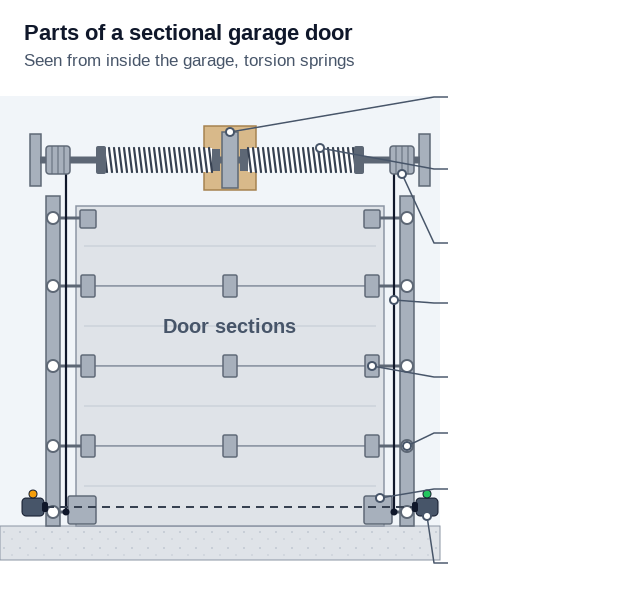
DASMA's TDS-167 checklist says: "If a spring is broken, do not operate the door until the spring is replaced." Citing potential dangers, it tells owners not to try removing, repairing or adjusting springs, door parts or mounting surfaces (wood blocks, steel brackets, cables and the like); only a trained door systems technician, with proper tools and instructions, should make repairs or adjustments. Keep everyone out of the opening while the door is in motion. For a downed tree or limb, or one blocking a street, Charlotte's tree FAQ says to call emergency services immediately.
Charlotte FAQs
Does replacing a garage door with one of the same size need a Mecklenburg permit?
The county handout lists replacing doors in the same location at the same size as work that can be done without a permit, and G.S. 160D-1110(c)(1) exempts door replacement only within that subsection's limits: $40,000 or less, current State Building Code, and a single-family residence, farm building or commercial building. Header repair is on the handout's permit list, so ask Code Enforcement about anything beyond a straight swap.
Does plugging a new opener into an existing ceiling outlet need a licensed electrician?
G.S. 87-43.1(7) exempts installing cord-connected equipment that plugs into a permanently installed receptacle, but that exception does not cover installing the receptacle or a junction box. Putting in a new outlet is electrical contracting under G.S. 87-43 unless another exception, such as the owner exception in 87-43.1(5a), applies.
Can a replacement receptacle for the opener go in without a permit?
G.S. 160D-1110(a)(4) drops the permit for repairing or replacing a device such as a receptacle in a one- or two-family dwelling only when the new device has the same voltage and the same or less amperage, the work is performed by a person licensed under G.S. 87-43, and the installation meets the current State Building Code, including the North Carolina Electrical Code.
Sources
- N.C. General Statutes § 160D-1110, Building permits
- NC OSFM: Guidance Paper, GS 160D-1110(c) construction permit exceptions (10/19/2023)
- NC OSFM: Codes, current and past
- N.C. General Statutes § 87-1, general contractor defined
- N.C. General Statutes § 87-14, building permits and owner affidavit
- N.C. General Statutes § 87-43, electrical contracting
- N.C. General Statutes § 87-43.1, electrical licensing exceptions
- NC Licensing Board for General Contractors
- NC State Board of Examiners of Electrical Contractors
- City of Charlotte: Zoning FAQ
- City of Charlotte: Tree Management FAQ
- Mecklenburg Code Enforcement: permitting overview
- Mecklenburg Code Enforcement: Partner Agencies
- Mecklenburg Code Enforcement: Homeowner Internet Permitting
- Mecklenburg Code Enforcement: Electrical information for homeowners
- Mecklenburg County: When do you need a permit for residential work?
- Mecklenburg County: LUESA fee ordinance (no effective date printed)
- Census Bureau 2020 place list, North Carolina (st37)
- NCEI 1991-2020 annual normals file, Charlotte Douglas (USW00013881)
- DASMA TDS-155h: North Carolina wind load guide
- DASMA TDS-167 residential door and operator checklist
- 16 CFR Part 1211 on eCFR (garage door operators)
- CPSC direct final rule, 91 FR 68456, Federal Register
- Garage Door Repair Cost, HomeGuide (Jan. 6, 2026) (third-party estimate)
- Garage Door Dent Repair Cost, HomeGuide (July 17, 2025) (third-party estimate)
- Garage Door Cable Repair Cost, HomeGuide (Oct. 8, 2025) (third-party estimate)
Last reviewed 2026-11-10
Nearby Counties
Services Available in Charlotte
Garage Door Repair
Springs, openers, cables, tracks, rollers, and panels — honest diagnosis and repair from independent local garage door techs.
Learn more →Garage Door Spring Repair
Broken torsion or extension springs replaced by local techs — the most common garage door failure, and not a DIY job.
Learn more →Garage Door Opener Repair
Openers that grind, hum, or won't respond — diagnosis and repair or replacement quotes from local techs.
Learn more →Garage Door Cable & Track Repair
Snapped cables, doors off track, and crooked or jammed doors — stop using the door and get a local tech routed fast.
Learn more →Emergency Garage Door Repair
Door stuck open at night, off its tracks, or trapping a vehicle — send an emergency request to independent local techs.
Learn more →Garage Door Replacement & Installation
New and replacement garage doors — steel, insulated, carriage-style, and wind-rated — with written installed quotes from local installers.
Learn more →Free Tools Before You Call
Ballpark the cost or narrow down the problem before talking to a Charlotte provider.
Garage Door Repair Cost Estimator
Estimate what your garage door repair should cost — springs, cables, openers, panels, and off-track doors, scheduled or emergency.
Use the free tool →Garage Door Symptom Diagnoser — Why Won't My Door Open?
Door won't open, won't close, or reverses on its own? Answer a few questions to find the likely cause — and whether it's a safe DIY fix or a pro job.
Use the free tool →Garage Door Torsion Spring Calculator
Measure your torsion spring — wire size, inside diameter, length — and check whether it's correctly sized for your door, with winding turns included.
Use the free tool →Need help in Charlotte, NC?
Send the short form — urgent requests get priority routing.