Garage Door Repair in Mesa, AZ
Garage door repair typically runs $150–$350 nationally, per our cost guide. Independent local pros serving Mesa, Gilbert, Chandler and nearby areas. Describe the problem and we'll route your request — free, no obligation.
- Mark broken springs and trapped cars as emergencies
- Honest national price ranges published up front
- Independent local techs — not a national call center
- Free to use — no obligation, no markup
Fast response from independent local providers. No obligation.
Typical national cost$150 – $350Cost guide →Local Help in Mesa, AZ
Building work inside Mesa city limits is governed by Title 4 of the Mesa City Code. For houses, Section 4-3-2 deletes Sections R101.4 through R114.4 of the 2024 International Residential Code and points any reference to them to the Mesa Administrative Code (Title 4, Chapter 1). That makes Section 4-1-4(B), not the model code's R105.2, the place to look for work that needs no permit. Neither garage doors nor openers appear anywhere on it.
Among its building items is "Painting, papering, tiling, carpeting, cabinets, countertops, and similar finish work." The list also lets the Building Safety Director waive a building permit for other items where the nature of the work does not require one to obtain compliance with the chapter, the technical codes and other city ordinances, and it states that an exemption does not authorize work done in violation of those codes or any other city law or ordinance.
Separately, Section 4-1-4(D) requires no application or notice to the Building Safety Director for ordinary repairs to structures, replacement of lamps, or connecting approved portable electrical equipment to approved permanently installed receptacles. Under that subsection, a repair stops being ordinary if it cuts away a wall, a partition or part of either; removes or cuts a structural beam or load-bearing support; removes or changes a required means of egress, or rearranges parts of the structure in a way that affects egress requirements; or adds to, alters, replaces or relocates any standpipe, water supply, sewer, drainage, drain leader, gas, soil, waste, vent or similar piping, any electrical wiring, or mechanical or other work affecting public health or general safety. The subsection ends with the line "EXCEPTION: Work exempt from permits under Section 4-1-4(B) above." The code does not say whether a given door or opener job counts as ordinary, and it gives the Building Safety Director authority to interpret it, so describe the job to Mesa Permit Services before work begins.
Code editions: the city's Residential Construction page lists the 2024 International Codes, including the IRC, and the 2023 NEC. Section 4-3-1 adopts the 2024 IRC (Ord. No. 5981, Dec. 8, 2025), Section 4-4-2 adopts the 2023 NEC (Ord. No. 5982, Dec. 8, 2025), and Section 4-1-1(A) applies the current chapter and technical codes to permit applications received and accepted on or after January 8, 2026. The city's printable homeowner guide, marked 03-2025, still names the 2018 IRC, so treat the code text as current and confirm with Permit Services.
Mesa Service Details
What providers in this area actually see: coverage, common jobs, local pricing factors, and rules worth knowing.
Service Area Notes
- In the Census Bureau's 2020 place list, Mesa city is an incorporated place in Maricopa County. Gilbert town, Chandler city and Tempe city are separate incorporated places in Maricopa County, and Apache Junction city and Queen Creek town are listed in both Maricopa and Pinal counties. Mesa's Title 4 does not govern them; ask the building office of the town or city at the address.
- For an address in unincorporated Maricopa County, the county's Planning and Development Department says the services it provides there include building permit review and inspection.
Common Jobs in Mesa
- Spring replacement: torsion springs run $150 to $350 and extension springs $120 to $200 in HomeGuide's spring guide of October 27, 2025, with materials and replacement labor included. Its January 6, 2026 repair guide says most springs last 10,000 to 20,000 cycles, which it translates to about 7 to 14 years for most homes.
- Reinforcing an insulated door that bows in heat. DASMA's TDS-185 says preventive measures typically involve reinforcement, which could include horizontal struts across the back, with the size and number of struts varying with the bow and the factors it lists; it refers owners to the product manufacturer for recommendations, so ask each quote to name the reinforcement.
- Openers: HomeGuide's repair guide gives $100 to $200 as the average repair and $300 to $900 for installing a new one. Its July 10, 2025 opener guide lists a screw-drive unit at $200 to $500, unit only.
- Panels or a whole door: HomeGuide's repair guide prices one replacement panel at $300 to $900+, and installing a new door at $700 to $2,700 (single) or $1,000 to $3,500 (double).
What Drives Pricing Here
- The dollar figures above are HomeGuide's, from the three guides dated there; none gives Arizona or Mesa figures, and the opener guide calls its $600 figure a national average.
- The repair guide puts the average repair at $150 to $350, says the total depends on door type, material, extent of damage and local labor rates, and notes that minimum service fees may apply.
- City permit fees: Mesa's Residential Construction page says fees are based on estimated construction costs and that full payment is required before a permit is issued. Ask Permit Services for the current amount rather than relying on an old figure.
Permits & Local Rules
- Electrical items in Section 4-1-4(B)(2) that need no electrical permit include: portable motors or other portable appliances energized by a cord or cable with an attachment plug end connected to an approved receptacle, when that cord or cable is permitted by the Mesa Electrical Code; repair or replacement of fixed motors, transformers or fixed approved appliances of the same type and rating in the same location; repair or replacement of current-carrying parts of any switch, contactor or control device; installation of attachment plug receptacles, but not the outlets for them; and Class II and Class III low-energy power, control and signal circuits as the Electrical Code defines them. The city's Residential Construction page, by contrast, lists installing or modifying electrical systems among work that needs a construction permit, so ask Permit Services whether an opener swap or a new ceiling outlet fits an exempt item.
- Licensing: contractor licenses in Arizona come from the Registrar of Contractors (ROC). The statute's paragraph 14 exemption, A.R.S. § 32-1121(A)(14), reaches only a person other than a licensed contractor doing casual or minor work on a single undertaking or project, under one or more contracts, at an aggregate contract price below $1,000 counting labor, materials and all other items. Left out of that price, in the statute's words, is "any electrical fixture or appliance that was designed by the manufacturer, that is unaltered, unchanged or unmodified by any person, that can be plugged into a common household electrical outlet using a two-pronged or three-pronged electrical connector or that has internal batteries that do not exceed twelve volts in a single, series or parallel configuration and that does not use any other form of energy, including natural gas, propane or other petroleum or gaseous fuel, to operate or is attached by a nail, screw or other fastening device to the frame or foundation of any residential structure". It is unavailable if performing the job requires a local building permit; if the job is only part of a larger or major operation, whether the same or a different contractor undertakes it; if an operation is split into contracts under $1,000 (again leaving out that fixture and appliance wording) to evade the licensing chapter or otherwise; and for anyone whose advertising to the public omits the words "not a licensed contractor". Under subsection D it also never covers fire safety installation, maintenance and repair work as defined there, or any work that involves connecting to a natural gas, propane or other petroleum or gaseous fuel supply.
- Mesa's Residential Construction page and its homeowner guide say owner-occupied projects may not need a licensed contractor and send readers to ROC and the statute. The statute's owner exemption is paragraph 5 of subsection A; read its conditions there, or ask ROC, before relying on it. Where a project does require a contractor, the guide says a Contractor Licensure Verification Form must be submitted before the permit is issued.
- Checking a company: ROC's Before You Hire page points owners to its Contractor Search for the license record and asks them to confirm the license class covers the contracted work. It also recommends written estimates from three or more contractors, each stating the price and whose job it is to get building permits.
- Homeowners associations: ROC reminds owners that associations may restrict, under the CC&Rs, what is built and how, and puts the duty on the owner to pass CC&R restrictions, requirements and construction policies to the contractor before signing. In Arizona's planned community statute, A.R.S. § 33-1817(B)(3) provides that approval of a construction project's architectural designs, plans and amendments "shall not unreasonably be withheld."
Climate & Housing Notes
- NOAA NCEI's 1991–2020 annual normals for station USC00022782, which NOAA names E MESA, AZ US, list 176.5 days a year with a high of 90°F or more (ANN-TMAX-AVGNDS-GRTH090), 112.1 days with a high of 100°F or more (ANN-TMAX-AVGNDS-GRTH100), 11.1 days with a low of 32°F or less (ANN-TMIN-AVGNDS-LSTH032) and 10.76 inches of annual precipitation (ANN-PRCP-NORMAL). For the station's listed position (33.4192, -111.6444), the Census Bureau's geocoder returns Maricopa County but no incorporated place, so it is not shown inside Mesa's limits.
- Heat and insulated doors: DASMA's TDS-185 calls thermal bowing an inherent characteristic of doors with insulated bonded core sections, not a product defect; when one skin is significantly warmer than the other, the door bows toward the warmer one. It says a south-facing door in direct sunlight is more likely to bow than a north-facing door out of direct sunlight, and lists the top section rubbing on the top of the opening's header among field issues reported with an outward bow.
- Monsoon weather: NWS Tucson's Monsoon Safety page describes June 15 through September 30 as the period Southwest NWS offices have defined as "The Monsoon" and lists power and communication outages among its consequences. The NWS dust storm page says haboobs result from thunderstorm outflow winds and that the local NWS forecast office issues a Dust Storm Warning when one is happening in the area.
Neighborhoods & Suburbs Served
Mesa · Gilbert · Chandler · Tempe · Apache Junction · Queen Creek
Emergency Response Expectations
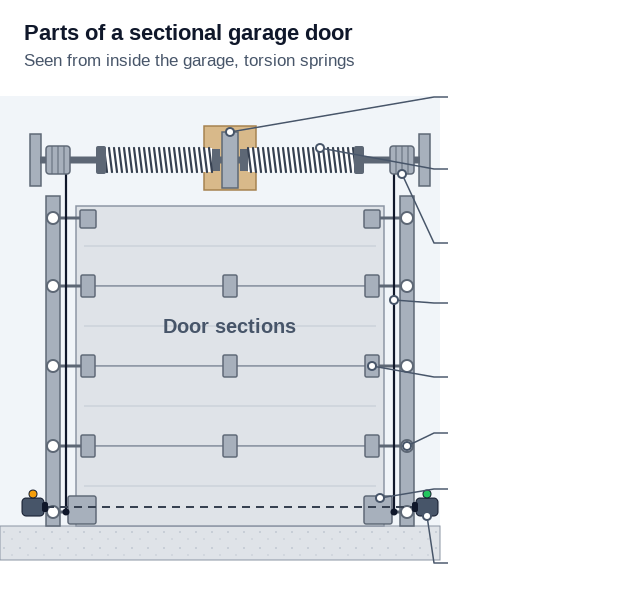
If a spring breaks, DASMA's TDS-167 checklist says: "If a spring is broken, do not operate the door until the spring is replaced." It adds not to try to remove, repair or adjust springs or any door parts or mounting surfaces, such as wood blocks, steel brackets or cables. Federal safety instructions (16 CFR 1211.16) warn against walking under a door that has stopped part-way open. Where an opener has an emergency release, they advise pulling it with the door closed when possible and taking care if the door is up, as weak or broken springs may let the door drop rapidly. If repair work that needs a Mesa permit has to be done in an emergency, Section 4-1-4(C) requires the permit application to be submitted within the next working business day.
Mesa FAQs
Do I need a Mesa permit to replace my garage door?
Mesa City Code Section 4-1-4(B) does not list garage doors among work exempt from permit, and the ordinary-repair allowance in Section 4-1-4(D) does not cover cutting structural members, changing egress, or adding to, altering, replacing or relocating electrical wiring, among the other limits quoted above. Before ordering a door, tell Permit Services whether the opening size, framing or wiring will change and ask whether a permit applies.
Can an unlicensed handyman work on my door in Mesa?
Only if one of the A.R.S. § 32-1121 exemptions fits. Paragraph 14, whose conditions are quoted under Permits above, drops away whenever a local building permit is required, so for a job that needs a Mesa permit, hire an ROC-licensed contractor unless some other exemption in that section covers it; ROC can answer questions about a specific job.
Which federal safety rules apply to my opener?
Part 1211 of 16 CFR applies to residential operators made on or after January 1, 1993 for sale in the U.S. Section 1211.7(b)(1)(i) has an opener on a vertically moving door begin reversing a closing door within 2 seconds of contacting the test obstruction, apart from the first foot of travel down from fully open, and then bring the door back to the full upmost position; paragraphs (b)(1)(ii) and (iii) list exceptions to that return. For vertically moving doors, Section 1211.6(b) also requires one of three secondary protection options, each with conditions that this site's Arizona page sets out. The CPSC's direct final rule of October 30, 2026 (91 FR 68456) revises the part to track UL 325; it is set to take effect December 29, 2026 if no significant adverse comments arrive by November 30, 2026.
How do I test the opener's reversing feature?
Lay a 1½-inch object, or a 2-by-4 flat, on the floor under the door and close it: the safety instructions that 16 CFR 1211.16 makes manufacturers supply say "Test door opener monthly", that the door must reverse on contact, and that the opener should be retested whenever its force or travel limit is adjusted.
Sources
- City of Mesa: Residential Construction (permit requirements and technical codes)
- Mesa City Code Title 4, Building Regulations (Sections 4-1-1, 4-1-3, 4-1-4, 4-3-1, 4-3-2, 4-4-2), as linked from the city's Residential Construction page
- City of Mesa: Residential Construction Homeowners Guide (03-2025)
- Arizona Legislature: A.R.S. § 32-1121, persons not required to be licensed
- Arizona Legislature: A.R.S. § 33-1817, planned community design and architectural committees
- Arizona Registrar of Contractors: License Classifications and licensing FAQ
- Arizona Registrar of Contractors: Before You Hire a Contractor
- eCFR: 16 CFR part 1211, Safety Standard for Automatic Residential Garage Door Operators
- Federal Register: CPSC direct final rule amending 16 CFR part 1211 (91 FR 68456, Oct. 30, 2026)
- NOAA NCEI 1991–2020 annual normals, E Mesa station (USC00022782)
- U.S. Census Bureau Geocoder: geographies for the USC00022782 station coordinates
- U.S. Census Bureau: 2020 place codes, Arizona
- Maricopa County Planning and Development
- National Weather Service Tucson: Monsoon Safety
- National Weather Service: Dust Storms and Haboobs safety
- DASMA TDS-185: Thermal Bowing of Garage Doors with Bonded Core Sections (trade association)
- DASMA TDS-167: Residential Sectional Garage Door and Electric Operator Checklist (trade association)
- HomeGuide: Garage Door Repair Cost (third-party estimate, Jan. 6, 2026) (third-party estimate)
- HomeGuide: Garage Door Spring Replacement Cost (third-party estimate, Oct. 27, 2025) (third-party estimate)
- HomeGuide: Garage Door Opener Installation Cost (third-party estimate, July 10, 2025) (third-party estimate)
Last reviewed 2026-11-09
Services Available in Mesa
Garage Door Repair
Springs, openers, cables, tracks, rollers, and panels — honest diagnosis and repair from independent local garage door techs.
Learn more →Garage Door Spring Repair
Broken torsion or extension springs replaced by local techs — the most common garage door failure, and not a DIY job.
Learn more →Garage Door Opener Repair
Openers that grind, hum, or won't respond — diagnosis and repair or replacement quotes from local techs.
Learn more →Garage Door Cable & Track Repair
Snapped cables, doors off track, and crooked or jammed doors — stop using the door and get a local tech routed fast.
Learn more →Emergency Garage Door Repair
Door stuck open at night, off its tracks, or trapping a vehicle — send an emergency request to independent local techs.
Learn more →Garage Door Replacement & Installation
New and replacement garage doors — steel, insulated, carriage-style, and wind-rated — with written installed quotes from local installers.
Learn more →Free Tools Before You Call
Ballpark the cost or narrow down the problem before talking to a Mesa provider.
Garage Door Repair Cost Estimator
Estimate what your garage door repair should cost — springs, cables, openers, panels, and off-track doors, scheduled or emergency.
Use the free tool →Garage Door Symptom Diagnoser — Why Won't My Door Open?
Door won't open, won't close, or reverses on its own? Answer a few questions to find the likely cause — and whether it's a safe DIY fix or a pro job.
Use the free tool →Garage Door Torsion Spring Calculator
Measure your torsion spring — wire size, inside diameter, length — and check whether it's correctly sized for your door, with winding turns included.
Use the free tool →Need help in Mesa, AZ?
Send the short form — urgent requests get priority routing.