Garage Door Repair in Alpharetta, GA
Garage door repair typically runs $150–$350 nationally, per our cost guide. Independent local pros serving Alpharetta, Johns Creek, Milton and nearby areas. Describe the problem and we'll route your request — free, no obligation.
- Mark broken springs and trapped cars as emergencies
- Honest national price ranges published up front
- Independent local techs — not a national call center
- Free to use — no obligation, no markup
Fast response from independent local providers. No obligation.
Typical national cost$150 – $350Cost guide →Local Help in Alpharetta, GA
In Alpharetta the permit question for door and opener work starts with Section 4.4.5A of the city's Unified Development Code, published on Municode. It requires an owner, authorized agent or prime contractor who wants to "construct, enlarge, alter, repair, move, demolish or change the occupancy of a building or structure" to apply to the Building Division and obtain a permit first. The same applies to erecting, installing, enlarging, altering, repairing, removing, converting or replacing a regulated electrical, gas, mechanical, plumbing, low voltage, energy conservation or fire protection system.
Two exception lists follow. Exception No. 1 covers only listed mechanical work, such as portable heating and cooling appliances. Exception No. 2 covers listed structures, among them retaining walls, small storage buildings, fences, driveways and roof covering replacements, each with limits set in the code, and those structures must still meet every other applicable code. Garage doors, springs and openers appear in neither list.
The section also lets "Ordinary minor repairs under $500.00 in total labor and materials cost" be made without a permit, "providing these minor repairs shall not violate any Code." Its examples, which it says are not the only ones, are exterior painting, installation of a window, air conditioning unit, replacement of windows, and installation of gutters. The general notes in the city's Residential Permitting Procedures (revised 2026) name only Exception No. 1 and Exception No. 2 as exempt work, so ask Inspection & Code Enforcement before relying on the $500 sentence for any door, spring or opener job.
Alpharetta Service Details
What providers in this area actually see: coverage, common jobs, local pricing factors, and rules worth knowing.
Service Area Notes
- Alpharetta appears as an incorporated city in Fulton County on the 2020 place list the Census Bureau publishes for Georgia. The city's code and permit procedures apply only inside its limits.
- The same list shows Johns Creek, Milton and Sandy Springs as separate incorporated cities in Fulton County and Roswell as a city spanning Cobb and Fulton; Alpharetta's rules do not govern them. Johns Creek's Building Division and Milton's Community Development Department publish their own permit guidance. Elsewhere, check which government issues permits at the property's address.
Common Jobs in Alpharetta
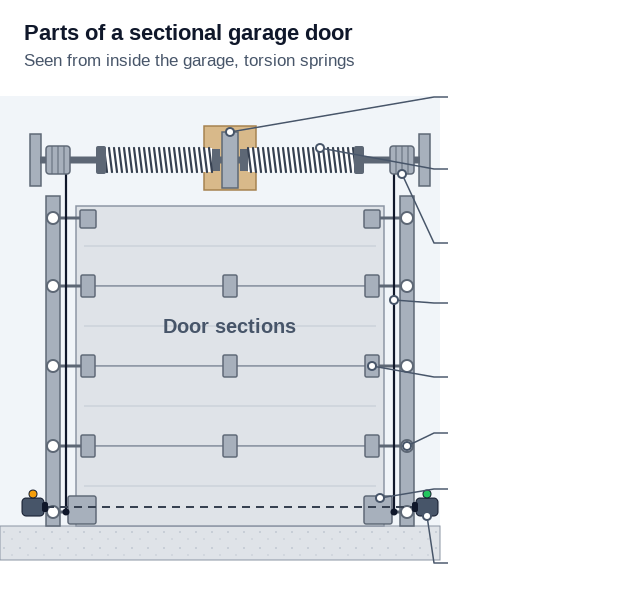
- Torsion or extension spring replacement
- Cable, roller, hinge and track repair
- Opener repair or replacement, followed by DASMA's photo-eye and contact-reversal checks
- Timer-to-close set-up, which 16 CFR 1211.14 bars on one-piece and swinging garage doors
- Section or full door replacement, after checking any subdivision covenant on door style
- A receptacle near the opener when none is within cord length; DASMA's checklist recommends an electrician install one and says use of an extension cord is not permitted
What Drives Pricing Here
- All prices in this section are from one HomeGuide guide, Garage Door Repair Cost (Tamatha Hazen, January 6, 2026). It names no Georgia location and warns that "minimum service fees can apply."
- Springs: replacing a pair runs $150 to $350 for top-mounted torsion springs and $120 to $200 for side-mounted extension springs in the guide.
- Openers: an average repair is $100 to $200 and installing a new unit is $300 to $900; on lifespan the guide says "Most openers last 10 to 15 years with regular use."
- Replacement: a single door installed is $700 to $2,700 and a double door $1,000 to $3,500 by HomeGuide's figures.
- City permit charges are not quoted here: the procedures explain how building permit fees are calculated, but carry only a "REVISED: 2026" label and no effective date. Ask Inspection & Code Enforcement for the current charge.
Permits & Local Rules
- Trade permits: the procedures require mechanical, electrical, low voltage and plumbing permits "prior to any MEP work or improvements being performed at the proposed work site." When no other work is planned or associated with the trade work, the city may issue a "Stand Alone" subcontractor permit without a building permit. If an opener job adds a receptacle or circuit, ask the city which permit applies.
- Trade licensing: citing O.C.G.A. 43-14, the procedures say anyone contracting or performing for hire any plumbing, electrical, low voltage, heating-air conditioning or utility work in Georgia must be licensed by the State Construction Industry Licensing Board for that work, and the city will not issue trade permits to non-licensed persons, except that a homeowner performing his own subcontractor work on his personal home may obtain his own permit for that work.
- Contractor licensing: the procedures say a state contractor's license has been required for residential contracting in Georgia since July 1, 2008, that some trades doing work limited to that trade are exempt if the state classifies them as "Limited Specialty Contractors," and that the office can be asked when in doubt. The state licensing board's own list is titled Traditional Specialty Contractors (revised 03/06/20); it names "Overhead Doors" and calls itself "under development and subject to change."
- Limits on that exemption: under O.C.G.A. 43-41-17(f), the specialty exemption gives no permission to do work within the licensing requirements of Chapter 14 of Title 43 without a license under that chapter. The subsection also lets such a contractor perform, for an owner, work otherwise requiring a Chapter 41 license where the total scope is predominantly its exempt specialty, provided the other work "is incidental to and an integral part of the exempt work" and "does not exceed the greater of $10,000.00 or 25 percent of the total value at the time of contracting of the work to be performed." Subsection (g) is a separate route for repair work done for an owner by someone who tells the owner they hold no license under the chapter, as long as the job does not touch the structural integrity of the real property; the statute leaves the meaning of "repair" to board rules.
- Codes: the procedures list the 2024 International Residential Code and the 2023 National Electrical Code, each with Georgia amendments, for one- and two-family dwellings, one-family townhouses of up to three stories and accessory structures "permitted on/after 1/1/2026." The Department of Community Affairs is not consistent on timing: its memo of December 1, 2025 sets January 1, 2026 as the effective date, but its public notice of December 09, 2025 adopts the same codes "with an effective date of January 1, 2027." Confirm with the city which edition governs your permit.
- Covenants: the procedures say most subdivisions in the city have covenants or restrictions, and the Community Development Department strongly encourages homeowners in those subdivisions to consult their association and seek its written approval before obtaining a building permit. An association's approval, they add, "does not authorize you to begin construction"; city building permits are still required for construction work in a subdivision.
Climate & Housing Notes
- City design criteria: the procedures' climatic and geographical table, which applies to residential buildings and ancillary structures on residential lots, lists "22°F Winter and 92°F Summer design dry bulb" temperatures, a wind speed of "90 mph (3 second gust) / 75 mph (fastest mile)", decay damage "Severe" and termite damage "VERY Heavy". The table says design temperatures do not apply to unheated structures. If a repair uncovers damaged wood framing around the opening, ask the city whether fixing it needs a permit.
- Nearby climate station: for ATLANTA PEACHTREE AP (USW00053863), NCEI's 1991-2020 annual normals list ANN-PRCP-NORMAL 51.43 inches, ANN-TMAX-AVGNDS-GRTH090 53.2 days (highs of 90°F or more) and ANN-TMIN-AVGNDS-LSTH032 48.8 days (lows of 32°F or less). All three carry NCEI's "R" (representative) flag for a record of 10 or more years, and they describe that airport, not Alpharetta.
- Federal opener standard: by 16 CFR 1211.1, the standard reaches "all residential garage door operators manufactured on or after January 1, 1993 for sale in the United States." Section 1211.7(b)(1)(i) requires a closing door, other than in the first 1 foot (305 mm) of travel from the full upmost position, to begin reversing within 2 seconds of contact with the rule's test obstruction and then return to the full upmost position, with exceptions in (b)(1)(ii)-(iii) for a second obstruction or a stop command while the door rises.
- On top of that reversal, a vertically moving operator has to satisfy one of the further options set out in 1211.6(b), each carrying its own conditions; see the eCFR text for them.
- Rule change pending: CPSC's direct final rule at 91 FR 68456, published October 30, 2026, extends Part 1211 to battery-powered operators and operators with battery back-up systems. Its effective date is December 29, 2026; if CPSC gets a timely significant adverse comment (the deadline is November 30, 2026), the agency says it will publish a withdrawal notice before that date.
Neighborhoods & Suburbs Served
Alpharetta · Johns Creek · Milton · Roswell · Sandy Springs
Emergency Response Expectations
For a broken spring, the DASMA checklist warns against running the door before the spring is replaced and against trying to remove, repair or adjust springs, cables, brackets or other door parts; it says all repairs and adjustments must be performed by a trained door systems technician using proper tools and instructions. Keep people clear of the opening while the door is moving. Inside Alpharetta, the city's procedures say night or weekend emergency repairs still require a subcontractor permit, which the installer must obtain on the next City business day during normal permit issue hours.
Alpharetta FAQs
Do I need an Alpharetta permit for a new garage door?
Neither exception list in UDC Section 4.4.5A names garage doors, and the code's under-$500.00 minor-repair allowance is not mentioned in the city's procedures. Ask Inspection & Code Enforcement about your specific job before ordering a door.
Our homeowners association approved the new door. Can work start?
Not on that approval alone if the job needs a city permit. The city's procedures also tell homeowners to require hired contractors and subcontractors to provide a City issued permit for their work, showing the work site address, before allowing them to proceed.
Can I turn on timer-to-close with my smart opener?
16 CFR 1211.14 allows unattended closing only when the operator system meets added requirements, among them one or more intentional actions to turn the feature on and an audible and visual alarm signal for a minimum of 5 seconds before any unattended closing movement. It is not permitted on one-piece or swinging garage doors, and an operator sold for both sectional and one-piece or swinging doors must identify, through its instructions and markings, that the feature may be enabled only when installed with a sectional door.
How do I check my opener's safety reverse?
DASMA's TDS-167 checklist (revised 4/23) runs both tests from a fully open door while you stand inside the garage, safely away from its path. Wave an object through the photo-eye beam as the door closes; then lay a 1½-inch high solid object, such as a 2x4, flat on the floor under the center of the door and close the door onto it. Each time the door should reverse and return to fully open. If not, DASMA says to stop and contact a trained door systems technician.
What if the opener has no photo-eyes?
DASMA's checklist says to check the operator's manual for entrapment protection information and whether the manufacturer can verify an alternate secondary protection; an operator without entrapment protection features should be replaced.
Sources
- City of Alpharetta: Residential Permitting Procedures (revised 2026)
- City of Alpharetta Unified Development Code, Section 4.4 (Municode)
- Georgia licensing board: Traditional Specialty Contractors list
- O.C.G.A. Chapter 43-41 as posted by the Secretary of State
- Office of the Governor: SB 503 (2024) as passed
- Georgia DCA memo: codes effective January 1, 2026 (December 1, 2025)
- Georgia DCA announcement: codes effective January 1, 2027 (December 09, 2025)
- eCFR: 16 CFR Part 1211
- Federal Register: CPSC direct final rule, 91 FR 68456 (October 30, 2026)
- DASMA TDS-167 garage door and operator checklist
- NOAA NCEI: 1991-2020 annual normals, Atlanta Peachtree airport (USW00053863)
- U.S. Census Bureau: 2020 Georgia place codes file
- City of Johns Creek: Building Permit Guidelines
- City of Milton: Building
- HomeGuide: Garage Door Repair Cost (January 6, 2026) (third-party estimate)
Last reviewed 2026-11-08
Services Available in Alpharetta
Garage Door Repair
Springs, openers, cables, tracks, rollers, and panels — honest diagnosis and repair from independent local garage door techs.
Learn more →Garage Door Spring Repair
Broken torsion or extension springs replaced by local techs — the most common garage door failure, and not a DIY job.
Learn more →Garage Door Opener Repair
Openers that grind, hum, or won't respond — diagnosis and repair or replacement quotes from local techs.
Learn more →Garage Door Cable & Track Repair
Snapped cables, doors off track, and crooked or jammed doors — stop using the door and get a local tech routed fast.
Learn more →Emergency Garage Door Repair
Door stuck open at night, off its tracks, or trapping a vehicle — send an emergency request to independent local techs.
Learn more →Garage Door Replacement & Installation
New and replacement garage doors — steel, insulated, carriage-style, and wind-rated — with written installed quotes from local installers.
Learn more →Free Tools Before You Call
Ballpark the cost or narrow down the problem before talking to an Alpharetta provider.
Garage Door Repair Cost Estimator
Estimate what your garage door repair should cost — springs, cables, openers, panels, and off-track doors, scheduled or emergency.
Use the free tool →Garage Door Symptom Diagnoser — Why Won't My Door Open?
Door won't open, won't close, or reverses on its own? Answer a few questions to find the likely cause — and whether it's a safe DIY fix or a pro job.
Use the free tool →Garage Door Torsion Spring Calculator
Measure your torsion spring — wire size, inside diameter, length — and check whether it's correctly sized for your door, with winding turns included.
Use the free tool →Need help in Alpharetta, GA?
Send the short form — urgent requests get priority routing.