Garage Door Repair in Pinellas County, FL
Garage door repair typically runs $150–$350 nationally, per our cost guide. Independent local pros serving St. Petersburg, Clearwater, Largo and nearby communities. Describe the problem and we'll route your request — free, no obligation.
- Mark broken springs and trapped cars as emergencies
- Honest national price ranges published up front
- Independent local techs — not a national call center
- Free to use — no obligation, no markup
Fast response from independent local providers. No obligation.
Typical national cost$150 – $350Cost guide →Local Help in Pinellas County, FL
Which office permits garage door work in Pinellas County depends on the address. The county's municipalities page counts 24 incorporated municipalities and says the County serves unincorporated residents, meaning all property not within city limits. Its Unincorporated Areas page places those areas between the Pasco County line and Tierra Verde and lists building permitting among the municipal services their taxing unit pays for.
Pinellas County Building and Development Review Services issues permits for unincorporated Pinellas and, according to the county's list of building departments, for Belleair Beach, Belleair Shore, Indian Rocks Beach, Kenneth City, Safety Harbor and Oldsmar. For each other city the list gives a separate building department contact, noting that all of Redington Beach's building department services are administered by the Town of Redington Shores Building Department. The county's permitting guide asks applicants in the cities it serves to verify with the city whether a preapproval letter is required and, if so, to upload it with the permit.
The wind design figure is countywide. A local technical amendment to the Florida Building Code, 8th Edition (2023), approved on behalf of the Pinellas County Construction Licensing Board (PCCLB), sets ultimate design wind speeds for "All incorporated and unincorporated Pinellas County": 145 mph for Risk Category II, with 135, 155 and 157 mph for Risk Categories I, III and IV, each "with interpolation permitted as allowed in the Code and ASCE 7-16". Section 1609.3 uses that speed to determine wind loads.
Pinellas County Service Details
What providers in this area actually see: coverage, common jobs, local pricing factors, and rules worth knowing.
Service Area Notes
- Palm Harbor, East Lake, Lealman and Tierra Verde are census designated places in Pinellas County on the Census Bureau's 2020 place list, not incorporated cities. The county suggests its My Neighborhood Services search or the Property Appraiser's website to verify an address's jurisdiction.
- Cities outside the county's permitting service apply their own procedures, and Hillsborough, Pasco and Manatee County addresses follow those counties' and cities' rules.
Common Jobs in Pinellas County
- Replacing a door with a product-approved assembly rated for the design pressure at the opening
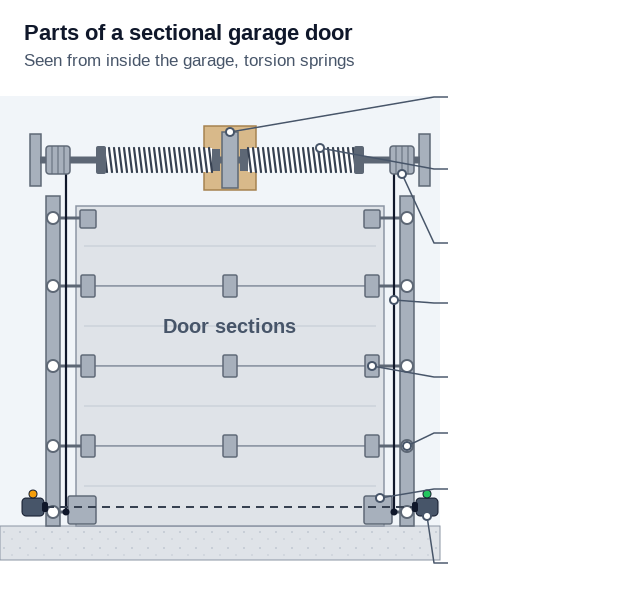
- Spring and cable replacement
- Straightening or replacing bent tracks, rollers and hinges after a door comes off its tracks
- Realigning or replacing photoelectric safety sensors when a door reverses or will not close
- Opener replacement; adding a receptacle for it is separate electrical work
- Permit or exemption paperwork: product approval, installation drawings and, where required, a recorded notice of commencement
What Drives Pricing Here
- None of the HomeGuide figures here are specific to Pinellas or to Florida. In the hurricane garage door guide (June 3, 2025), an installed single door runs $1,200 to $6,000 and an installed double $2,000 to $10,000, and doors with higher WindCode ratings and Exposure Categories are described as generally more expensive.
- HomeGuide's cable repair guide (October 8, 2025) gives $150 to $250 for its standard cable replacement line, the job of swapping both cables, and its opener guide (July 10, 2025) gives $300 to $900 on average with installation.
- Electrical scope: the PCCLB's garage door specialty definition sends incidental receptacle, light and switch work to a licensed electrical contractor, and Clearwater lists a Final Electric (204) inspection when electric is included; ask whether a quote covers that work.
Permits & Local Rules
- State exemption: s. 553.79(1)(g)1., Florida Statutes, obliges every local government that issues building permits to excuse the owner of a single-family dwelling, or that owner's contractor, from needing a building permit for work on the owner's property valued below $7,500. Subparagraph 2. leaves out work on property located partially or entirely within a flood hazard area, using the Florida Building Code's definition, and any electrical, plumbing, structural, mechanical or gas work on property containing a single-family dwelling, and it forbids splitting one construction project into several to get around the paragraph. Under subparagraph 3., the owner or contractor qualifies by filing a written exemption request with the local enforcement agency, supported by a contract copy or other documentation demonstrating the work's nature and value, and subparagraph 4. disclaims any legal duty of the local government toward the owner, the contractor, or their successors or assigns for exempted work.
- Pinellas County's exemption page says the exemptions took effect July 1, 2026 for unincorporated Pinellas County and lists "Overhead Garage Doors" among projects that may qualify. The county requires its Building Official's approval before exempt work proceeds. Requests go to the Building Official through the county's Access Portal or in person, with documentation describing the work and a copy of the signed contract; in-person applications use an exemption request form and need a signed contract if a contractor is used. The page lists gas, electrical, mechanical, plumbing and structural work as not qualifying and describes the flood exclusion as properties in a Flood Zone or Flood Hazard Area. The stamped, approved request must stay on the job site for Code Enforcement review, or a Stop Work Order may follow, and county staff do not inspect exempt work, leaving owners and contractors responsible for its compliance. The page does not address the cities the county permits for; ask before relying on it there.
- County permits: depending on the permit type, the permitting guide's intake checklist may call for a Florida Product Approval List and, for any project value over $5,000 for building trade and $15,000 for mechanical equal changeouts, a recorded Notice of Commencement, which it says Florida statute requires onsite for each inspection. Separately, s. 553.842(5) names exterior doors in its list of product categories for which the Florida Building Commission must use one of the subsection's statewide approval methods.
- Safety Harbor: the city's permits page says that under an Interlocal Agreement in effect since May 1, 2021, window, door and garage door permit applications are submitted solely to Pinellas County using the county's forms and procedures, and the county inspects for Florida Building Code compliance. Structures in the Special Flood Hazard Area must first be reviewed by the city for Substantial Improvement and Substantial Damage (the 49% rule) before submittal to the county.
- Clearwater: the city's shutter and garage door handout, marked updated August 25, 2025 (before the July 1, 2026 exemption date the county gives), says permits are required for all new and replacement shutter and garage door installations, with a Notice of Commencement on jobs valued at $5,000.00 or more and the manufacturer's specifications on site at inspection. Minimum inspections are Final Building (110), plus Final Electric (204) if electric is included, but contractors may instead file the city's certification form, also signed by the customer to acknowledge there may be no inspections, certifying installation to the manufacturer's requirements and all applicable codes including the 145-mph wind load and electrical code requirements; the city may randomly inspect and may revoke self-certification at any time. Plan and posting requirements are in the handout; ask the city how it now treats exemption requests.
- Who may install in Clearwater: the handout lists a licensed general contractor, a licensed residential contractor for residential installations, and a garage door specialty contractor licensed with the PCCLB. It also mentions an Owner/Builder affidavit form; owner-builder eligibility is set by s. 489.103(7), Florida Statutes, so ask Clearwater whether a job qualifies.
- Local license: the PCCLB says it regulates certain construction and home improvement contractors practicing in Pinellas County, including all local municipalities. Its specialty licensing notice, updated in May 2024, lists Garage Door Specialty (class code 86) among classifications that "continue as the job scopes substantially correspond to one of the new specialty contractor categories to be established by the Construction Industry Licensing Board (CILB) by July 1, 2025". Under s. 489.117(4)(a), a local government may not require a state or local license for a job scope that does not substantially correspond to the categories that paragraph lists, or require one to obtain a permit for such a scope, subject to carve-outs the Florida guide on this site covers. Confirm the class 86 license's current status with the PCCLB or DBPR, and look up any state license on DBPR's licensee search.
- Scope of that license: the PCCLB's classification sheet (effective 10/1/07) limits a garage door specialty contractor to the fabrication, assembling, handling, erection, installation, dismantling, adjustments, alteration, repair and servicing of all types of garage doors, with their related hardware and operating devices. It may install low voltage wiring for safety features and cord and cap connections, but any other incidental electrical work, including and limited to receptacles, lights and switches, must be subcontracted to a licensed electrical contractor, and it may not contract for another trade's work.
- State-certified contractors: a PCCLB notice says they no longer have to register or renew with the PCCLB but may have to register or have the state license verified with each local building department to pull a permit or schedule inspections, with proof of general liability and workers' compensation insurance (or exemption) naming that jurisdiction as certificate holder. The county's Register a State Contractor's License page still says Pinellas County requires state-certified contractors to register their license with the county and provide proof of insurance; ask the building department for the address which applies.
- Flood zones: for a home in a flood zone, ask the building department for the address how a door job counts toward substantial improvement before work starts. Pinellas County's definition, and the exception a PCCLB-approved amendment of January 13, 2025 adds to it, are set out in that amendment, linked below.
Climate & Housing Notes
- NOAA's 1991-2020 annual normals for station USW00092806, named ST PETERSBURG AP in the NCEI file, give ANN-TMAX-AVGNDS-GRTH090 = 70.9, the annual number of days with a maximum temperature of 90F or more; ANN-TMIN-AVGNDS-LSTH032 = 0.1, days with a minimum of 32F or less; and ANN-PRCP-NORMAL = 46.65 inches of annual precipitation.
- Helene (September 2024): the NWS Tampa Bay Area post tropical cyclone report lists water levels of 6.67 feet at the Clearwater Beach tide gauge and 6.31 feet at St. Petersburg, both on the MHHW (mean higher high water) datum.
- Milton (October 2024): the NWS Tampa Bay Area report lists an 88-knot gust at Albert Whitted Airport and 20.40 inches of rain at the St. Petersburg 2.5 S CoCoRaHS station. Both reports say: "It is unlikely that the point-based observations provided in this report sampled the peak values for the event."
Communities Served
St. Petersburg · Clearwater · Largo · Pinellas Park · Dunedin · Tarpon Springs · Seminole · Safety Harbor · Oldsmar · Gulfport · St. Pete Beach · Treasure Island · Madeira Beach · Indian Rocks Beach · Palm Harbor · East Lake · Lealman · Tierra Verde
Emergency Response Expectations
Requests from this page go to independent providers; this site sends no one out itself, and after a named storm a provider may not be free right away. If officials order your zone to evacuate, leave rather than wait on a repair.
Pinellas County FAQs
When does the under-$7,500 exemption cover a garage door job in unincorporated Pinellas?
When every condition holds: the owner's single-family property, work valued under $7,500, no part of the property in a flood hazard area, no electrical, plumbing, structural, mechanical or gas work, no splitting of a project to get under the limit, and the Building Official's approval of the written request before work begins. Otherwise, ask Building and Development Review Services which permit, if any, the job needs.
Why will my opener not close the door when a safety sensor is unplugged or faulty?
16 CFR part 1211 covers residential openers manufactured from January 1, 1993 onward for sale in the United States. Section 1211.8(c) has an operator monitor an external secondary entrapment device, such as a photoelectric sensor, at least once during each close cycle. If the device is missing, or a fault such as an interrupted wireless signal or an open or short circuit in its wiring keeps it from sensing an obstruction, a closing vertically moving door must open and an open one must not close more than 1 foot below the upmost position. The alternative is the section 1211.6(b)(1) design, which needs "constant pressure on a control intended to be installed and activated within line of sight of the door to lower the door", a door that reverses to the upmost position if the pressure ends before the operator reaches its lower limit, and a portable transmitter, if one is supplied, that can only open the door. CPSC's direct final rule of October 30, 2026 (91 FR 68456) would remove the words "and correct operation" from that monitoring duty. CPSC set December 29, 2026 as its effective date, and says that if a timely significant adverse comment comes in (the deadline is November 30, 2026) it will publish a notification withdrawing the rule before then.
Storm water reached the garage. Can I run the opener?
Ready.gov's after-hurricane guidance says not to touch electrical equipment if it is wet or if you are standing in water and, if it is safe to do so, to turn off electricity at the main breaker or fuse box to prevent electric shock. Have the opener and its outlet checked before using them. Replacing an outlet is electrical work, which the under-$7,500 exemption does not cover.
Sources
- Pinellas County: Permit Exemptions for Work Under $7,500
- Pinellas County: Permitting Guide
- Pinellas County: Building Departments in Pinellas County
- Pinellas County: Municipalities and Cities
- Pinellas County: Unincorporated Areas
- Pinellas County: Register a State Contractor's License
- Florida Statutes (2026), s. 553.79
- Florida Statutes (2026), s. 553.842
- Florida Statutes (2026), s. 489.103
- Florida Statutes (2026), s. 489.117
- PCCLB amendment: FBC s. 1609.3 wind speeds (PDF)
- PCCLB amendment: substantial improvement, approved 1/13/25 (PDF)
- PCCLB: specialty licensing notice, updated May 2024 (PDF)
- PCCLB: description of contractor classifications (PDF)
- PCCLB: notice to state certified contractors (PDF)
- PCCLB: Construction Licensing Board home page
- Florida DBPR: Licensee search
- City of Safety Harbor: Permits
- City of Clearwater: shutter and garage door requirements (PDF)
- eCFR: 16 CFR Part 1211 (garage door operators)
- Federal Register: CPSC direct final rule, 91 FR 68456 (Oct. 30, 2026)
- Ready.gov: Hurricanes
- NWS Tampa Bay: Helene report (PDF)
- NWS Tampa Bay: Milton report (PDF)
- NOAA NCEI 1991-2020 normals, USW00092806
- U.S. Census Bureau: 2020 Florida place codes
- HomeGuide: Hurricane Garage Door Cost (June 3, 2025) (third-party estimate)
- HomeGuide: Garage Door Cable Repair Cost (October 8, 2025) (third-party estimate)
- HomeGuide: Garage Door Opener Installation Cost (July 10, 2025) (third-party estimate)
Last reviewed 2026-11-08
Services Available in Pinellas County
Garage Door Repair
Springs, openers, cables, tracks, rollers, and panels — honest diagnosis and repair from independent local garage door techs.
Learn more →Garage Door Spring Repair
Broken torsion or extension springs replaced by local techs — the most common garage door failure, and not a DIY job.
Learn more →Garage Door Opener Repair
Openers that grind, hum, or won't respond — diagnosis and repair or replacement quotes from local techs.
Learn more →Garage Door Cable & Track Repair
Snapped cables, doors off track, and crooked or jammed doors — stop using the door and get a local tech routed fast.
Learn more →Emergency Garage Door Repair
Door stuck open at night, off its tracks, or trapping a vehicle — send an emergency request to independent local techs.
Learn more →Garage Door Replacement & Installation
New and replacement garage doors — steel, insulated, carriage-style, and wind-rated — with written installed quotes from local installers.
Learn more →Free Tools Before You Call
Ballpark the cost or narrow down the problem before talking to a Pinellas County provider.
Garage Door Repair Cost Estimator
Estimate what your garage door repair should cost — springs, cables, openers, panels, and off-track doors, scheduled or emergency.
Use the free tool →Garage Door Symptom Diagnoser — Why Won't My Door Open?
Door won't open, won't close, or reverses on its own? Answer a few questions to find the likely cause — and whether it's a safe DIY fix or a pro job.
Use the free tool →Garage Door Torsion Spring Calculator
Measure your torsion spring — wire size, inside diameter, length — and check whether it's correctly sized for your door, with winding turns included.
Use the free tool →Need help in Pinellas County, FL?
Send the short form — urgent requests get priority routing.