Garage Door Repair in Austin, TX
Garage door repair typically runs $150–$350 nationally, per our cost guide. Independent local pros serving Round Rock, Pflugerville, Cedar Park and nearby areas. Describe the problem and we'll route your request — free, no obligation.
- Mark broken springs and trapped cars as emergencies
- Honest national price ranges published up front
- Independent local techs — not a national call center
- Free to use — no obligation, no markup
Fast response from independent local providers. No obligation.
Typical national cost$150 – $350Cost guide →Local Help in Austin, TX
The City of Austin Development Services Department (DSD) keeps a Work Exempt from Building Permits page, and item 20 on its residential building list reads: "Replacing or installing an overhead garage door on a garage." DSD says the residential exemptions "apply to one- and two-family dwellings and townhouses not more than three stories," and that work exempt from a permit must still comply with applicable Building Codes, City Codes, and all other applicable ordinances.
That entry covers the door. An opener can bring in electrical work, and the residential electrical items on the same page are narrow. They include "Reinstallation of attachment plug receptacles but not the outlets" and "Electrical wiring, devices, appliances, apparatus, or equipment operating at less than 25 volts and not capable of supplying more than 50 watts of energy." Adding a new outlet or circuit is not among them, so ask DSD what the electrical side of an opener job needs before anyone starts.
State law governs who may do that electrical side. TDLR's electricians page states: "Anyone who performs, or offers to perform, non-exempt electrical work in the state of Texas must be licensed and perform that work through a licensed electrical contractor." Garage door work does not appear as its own category in TDLR's menu of regulated industries. For the chapter 1305 exemptions, the coastal windstorm program and statewide insurance rules, see this site's Texas garage door page.
Austin Service Details
What providers in this area actually see: coverage, common jobs, local pricing factors, and rules worth knowing.
Service Area Notes
- The permit and historic-review details on this page are the City of Austin's own rules.
- The 2020 Census Gazetteer place file for Texas lists Round Rock, Pflugerville, Cedar Park, Leander, Georgetown, Kyle, Buda and Manor as cities in their own right. Austin's exempt-work list does not apply in them; ask that city's permit office what a door or opener job needs.
- For a house on unincorporated land, ask the county permit office and, where the address lies in a city's extraterritorial jurisdiction, that city as well. The Texas page summarizes Local Government Code chapter 233 for those areas.
Common Jobs in Austin
- Replacing or newly installing an overhead door at a home within DSD's residential exemptions (item 20)
- Opener replacement: the federal standard in part 1211 of 16 CFR covers residential openers made for the U.S. market with a manufacture date of January 1, 1993 or later, and a new receptacle is electrical work
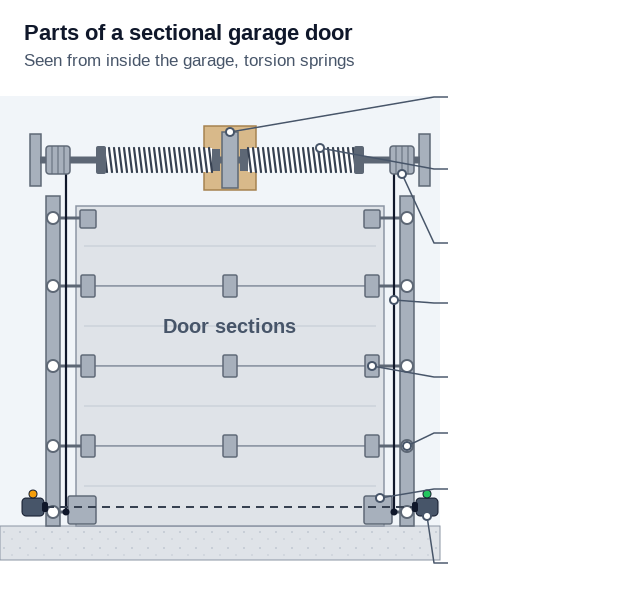
- Torsion or extension spring and cable repairs, work DASMA's checklist reserves for a trained technician
- Dent repair on one or more panels, or a whole new door where the damage spreads across sections
- Photo-eye alignment and safety-reverse checks after an opener or door repair
What Drives Pricing Here
- The figures below are HomeGuide's national estimates, not Austin quotes; local bids can differ.
- Springs: HomeGuide's spring replacement guide (Tamatha Hazen, October 27, 2025) prices spring and cable replacement at $200 to $500, torsion springs alone at $150 to $350 and extension springs at $120 to $200, and gives torsion springs a life of 7 to 14 years or 10,000 to 20,000 cycles.
- Openers: HomeGuide's opener installation guide (Jennifer Carlson, July 10, 2025) puts the average installed price of an opener at $300 to $900, with the unit alone at $150 to $500 and labor at $150 to $400. It expects openers to last 10 to 15 years on average, depending on the horsepower, the garage door's weight, and how often you use it.
- Dents: HomeGuide's dent repair guide (Tamatha Hazen, July 17, 2025) lists $100 to $300 for minor damage, $250 to $400 for moderate damage and $600 to $1,500+ for multiple panel replacement, adding that for extensive damage affecting multiple panels, professionals most often recommend complete garage door replacement, which it puts at $700 to $3,500.
- City fees: DSD and historic review charges follow the city's current fee schedule, so this entry quotes no city fee amounts; ask the office for current rates.
Permits & Local Rules
- Item 21 on DSD's residential building list is "Replacing doors of the same size and operation," and the list ends with "Other work as determined by the building official." Among its residential code references the page names the Residential Code (Article 11) and the Electrical Code (Article 4) in chapter 25-12 of the Land Development Code. DSD's commercial exemption list has no garage door item, so for a commercial building ask DSD.
- Historic review is separate from the building permit. Austin's Historic Preservation Office says owners must go through it when the property is designated as a historic landmark, a contributing property in a local historic district or a contributing property in a National Register historic district (a noncontributing property in a local or National Register district for sign changes only), and they are planning exterior alterations or additions, permanent site work, sign installation, or stand-alone, ground-up new construction on a historic landmarked property or any property in a historic district. The office says routine maintenance and in-kind repairs do not require historic review.
- On timing, the office says small projects that qualify for administrative approval can be approved within 5 business days; staff may refer any project to the Historic Landmark Commission, which meets once a month, and Commission review involves additional fees. Ask the Historic Preservation Office whether a particular door change counts as an in-kind repair or an exterior alteration; its Historic Properties page lets owners check whether a property is historic.
- Deed restrictions are a private layer. Property Code § 202.001 defines a dedicatory instrument as each document governing the establishment, maintenance, or operation of a residential subdivision, planned unit development, condominium or townhouse regime, or any similar planned development, and a restrictive covenant as any covenant, condition, or restriction contained in one. DSD's exempt list says nothing about those documents, so read them, or ask the property owners' association, before ordering a door in a new style or color.
Climate & Housing Notes
- Heat: for the AUSTIN-CAMP MABRY, TX station (USW00013958), NOAA's 1991–2020 normals give 122.8 for ANN-TMAX-AVGNDS-GRTH090 and 28.7 for ANN-TMAX-AVGNDS-GRTH100, which NCEI's documentation defines as the annual number of days with maximum temperature >= 90F and >= 100F.
- Summer: the same station's summer value for JJA-TMAX-AVGNDS-GRTH100 (summer number of days with maximum temperature >= 100F) is 25.9.
Neighborhoods & Suburbs Served
Round Rock · Pflugerville · Cedar Park · Leander · Kyle · Buda · Manor · Georgetown
Emergency Response Expectations
This page passes requests along to independent garage door businesses and cannot promise when one will arrive. While a door hangs half open waiting for repair, keep everyone clear of it: item 4 of the federal user instructions for vertically moving doors reads "NEVER GO UNDER A STOPPED PARTIALLY OPEN DOOR."
Austin FAQs
Is a building permit needed to swap out a garage door in Austin?
DSD says a building permit is not required for the work on its exempt list, and item 20 of the residential list, which covers the dwellings described above, is replacing or installing an overhead garage door on a garage. The work must still meet the codes and ordinances the page names, a designated historic property may need historic review, and opener wiring beyond the listed electrical items is a separate question for DSD.
A spring on our garage door broke. Can we keep using the opener?
No. DASMA's TDS-167 checklist (Rev 4/23) says: "If a spring is broken, do not operate the door until the spring is replaced." It warns owners against removing, repairing or adjusting springs or other door parts themselves and leaves repairs and adjustments to a trained door systems technician. For openers that require an emergency release, the federal user instructions (16 CFR 1211.16(b)(2), item 6) say that, where possible, it should be pulled only with the door closed, call for caution when using it with the door open, and warn that a door with weak or broken springs may come down rapidly. DASMA adds that torsion springs sit on a shaft, which inherently provides containment, and asks owners of doors with extension springs to verify that a secure cable runs through the center of the springs to contain them.
Who may install a new outlet for an opener?
Occupations Code § 1305.151 bars performing or offering to perform electrical work without an appropriate license issued or recognized under chapter 1305, except as § 1305.003 provides. An owner who lives in the house is exempt under § 1305.003(a)(6) only for work in or on the dwelling that no municipal ordinance specifically regulates, and under § 1305.201(d), electrical work within a municipality's corporate limits "must be installed in accordance with all applicable local ordinances." Ask DSD how Austin's Electrical Code treats the outlet. DASMA's checklist asks whether a self-grounding or GFCI receptacle sits within cord length of the opener and says an extension cord is not permitted.
How can I check the safety reverse after a repair?
Work through the whole of DASMA's TDS-167 checklist (Rev 4/23) for a residential sectional garage door with an electric operator rather than a shortened version of it. The checklist says its steps should be performed in the order listed, and the reversal tests come near the end: item 15 checks the photoelectric sensors and item 16 is a contact test using a 1 1/2-inch-high solid object, such as a piece of 2x4 at least six inches long, laid flat under the center of the door. Item 16 notes that the door may need servicing, based on findings in earlier items, before that test is conducted. Most important, the checklist says that if you answer "No" to any of its questions, or encounter a problematic situation with the door, you should stop the inspection and have a trained door systems technician inspect and repair it.
Does a homeowners policy in Austin cover hail damage to the door?
TDI's windstorm insurance page says homeowners policies away from the coast probably include wind and hail coverage that pays much as it would for fire, lightning or theft, though you may have a different deductible for windstorm damage. Read your declarations page or ask your agent. State law on paying and waiving deductibles is summarized on this site's Texas page.
Sources
- Austin DSD: residential and commercial work exempt from permits
- Austin Historic Preservation Office: which projects need historic review
- TDLR: Electricians
- Occupations Code chapter 1305 (Texas Legislature statutes site)
- Texas Property Code ch. 202, restrictive covenants
- TDI windstorm insurance consumer page (last updated 6/1/2026)
- eCFR: 16 CFR part 1211, residential garage door operator standard
- DASMA Technical Data Sheet #167 (Rev 4/23), inspector and consumer checklist
- NOAA NCEI 1991–2020 annual/seasonal normals, AUSTIN-CAMP MABRY, TX (USW00013958)
- NOAA NCEI annual/seasonal normals documentation, 1991–2020
- U.S. Census Bureau 2020 Gazetteer place file, Texas
- HomeGuide spring replacement cost guide (national, October 27, 2025) (third-party estimate)
- HomeGuide opener installation cost guide (national, July 10, 2025) (third-party estimate)
- HomeGuide dent repair cost guide (national, July 17, 2025) (third-party estimate)
Last reviewed 2026-11-09
Services Available in Austin
Garage Door Repair
Springs, openers, cables, tracks, rollers, and panels — honest diagnosis and repair from independent local garage door techs.
Learn more →Garage Door Spring Repair
Broken torsion or extension springs replaced by local techs — the most common garage door failure, and not a DIY job.
Learn more →Garage Door Opener Repair
Openers that grind, hum, or won't respond — diagnosis and repair or replacement quotes from local techs.
Learn more →Garage Door Cable & Track Repair
Snapped cables, doors off track, and crooked or jammed doors — stop using the door and get a local tech routed fast.
Learn more →Emergency Garage Door Repair
Door stuck open at night, off its tracks, or trapping a vehicle — send an emergency request to independent local techs.
Learn more →Garage Door Replacement & Installation
New and replacement garage doors — steel, insulated, carriage-style, and wind-rated — with written installed quotes from local installers.
Learn more →Free Tools Before You Call
Ballpark the cost or narrow down the problem before talking to an Austin provider.
Garage Door Repair Cost Estimator
Estimate what your garage door repair should cost — springs, cables, openers, panels, and off-track doors, scheduled or emergency.
Use the free tool →Garage Door Symptom Diagnoser — Why Won't My Door Open?
Door won't open, won't close, or reverses on its own? Answer a few questions to find the likely cause — and whether it's a safe DIY fix or a pro job.
Use the free tool →Garage Door Torsion Spring Calculator
Measure your torsion spring — wire size, inside diameter, length — and check whether it's correctly sized for your door, with winding turns included.
Use the free tool →Need help in Austin, TX?
Send the short form — urgent requests get priority routing.